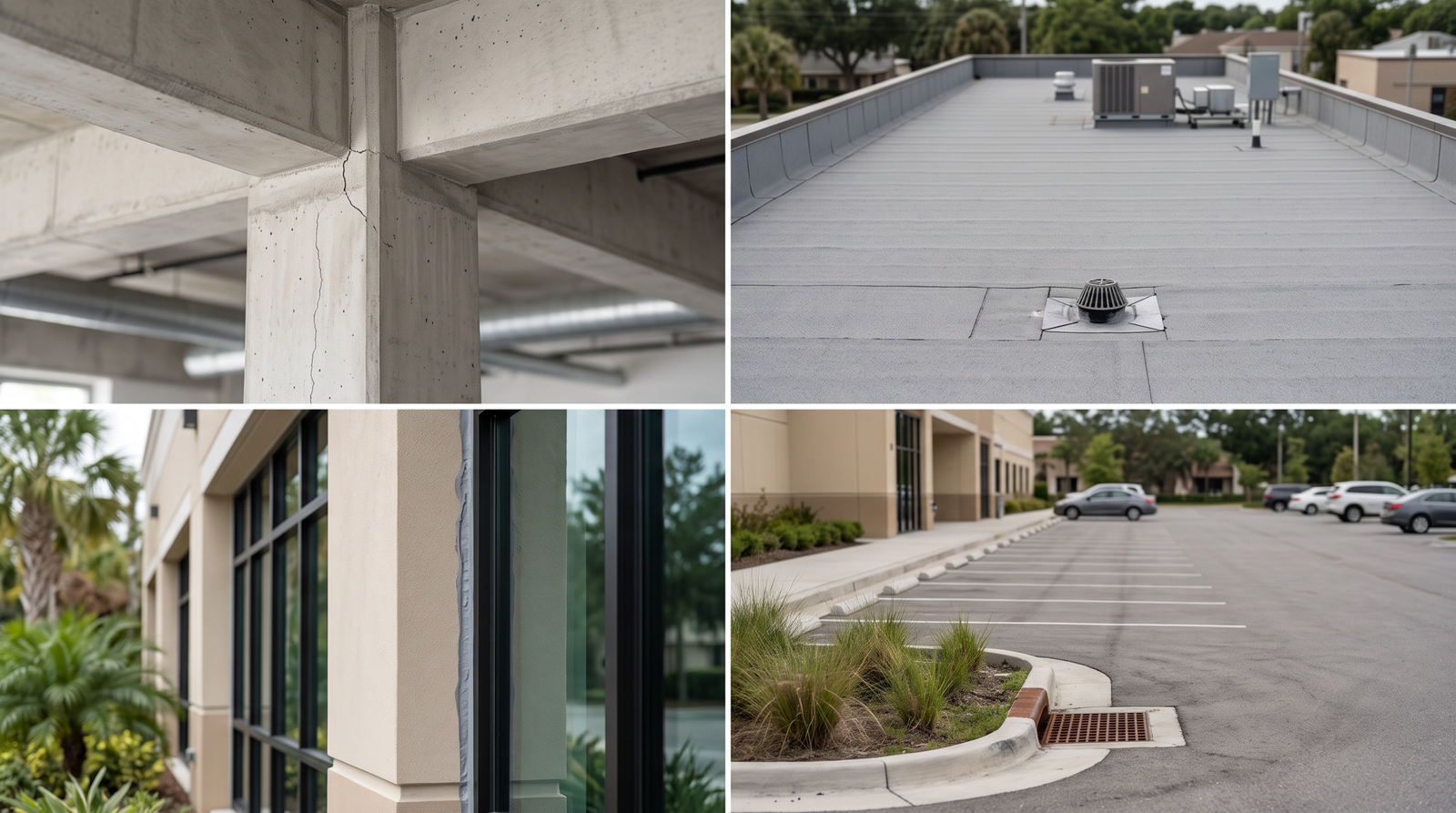

Commercial property owners need to plan for repairs before every project becomes an urgent expense. A property condition assessment helps organize that planning by documenting building conditions, identifying significant deficiencies and recommending appropriate next steps.
The assessment can connect current observations with near-term repairs and anticipated major work over a defined planning period. Its value lies in explaining priorities and assumptions clearly, rather than predicting an exact failure date or final construction price.
For owners, facility managers and asset managers, property condition assessment capital planning starts with an understanding of what the assessment establishes, what remains uncertain and how findings should be updated as conditions change.
Prema Consulting Group translates observed building conditions into prioritized repair and capital-planning inputs so owners can better sequence near-term and longer-term needs.
What a PCA Contributes to Capital Repair Planning
A property condition assessment, or PCA, evaluates commercial building and site conditions within an agreed scope. Accessible observations, available records and information from property personnel help identify deficiencies and relevant system conditions.
For planning assignments, the scope should define the systems assessed, the planning horizon and whether opinions of probable costs or anticipated replacement needs are included. A transaction-focused report should not automatically be assumed to provide every detail needed for an owner’s longer-term program.
Useful planning inputs may include:
- Documented significant deficiencies
- Recommended actions and repair priorities
- Available system age and repair history
- Anticipated work within the agreed planning period
- Planning-level cost opinions and assumptions
- Limitations and recommended follow-up investigations
These inputs help owners organize decisions. Developing repair details, obtaining contractor pricing and coordinating implementation may require additional work.
Start With Observed Conditions
Capital planning is more useful when it reflects the property’s actual condition rather than equipment age or a generic replacement schedule alone.
A roof nearing an assumed service life may remain serviceable, while a newer roof may have recurring leakage or installation-related concerns. Similarly, localized pavement deterioration and widespread drainage problems can imply different scopes and priorities.
An assessment should identify where conditions occur, what evidence supports the findings and how they affect the relevant system. Photographs, records and location references help property teams track items and coordinate follow-up.
The review should also distinguish directly observed conditions from reported history and inaccessible areas. An unresolved question may need investigation before a meaningful repair allowance can be developed.
Define the Planning Horizon
A planning horizon sets the period over which anticipated work is considered. The appropriate period depends on the owner’s objectives and required deliverables.
Property teams should confirm:
- Whether the assessment is intended for initial repairs, ongoing ownership or both
- The period covered by anticipated major work
- How repair timing will be expressed
- Which systems and cost categories are included
- How assumptions will be reviewed and updated
A longer horizon introduces more uncertainty about future condition, operating demands and costs. Reports should make those assumptions visible so owners can distinguish current deficiencies from anticipated future needs.
The horizon is a planning framework, not a guarantee that every listed component will require work within a particular year.
Separate Repair Priorities From Budget Timing
Engineering priority and an owner’s budget schedule are related but serve different purposes.
The assessment should explain the basis for recommended timing. Considerations may include observed severity, ongoing damage, operational implications, potential progression and unresolved technical questions.
Conditions Requiring Prompt Attention
Some findings warrant timely action or further evaluation. Potentially unsafe conditions should be communicated clearly and addressed appropriately rather than delayed solely to fit a capital cycle.
Near-Term Repairs and Investigation
Other findings may support planned corrective work or a targeted investigation. For example, recurring leakage may require diagnostic evaluation before interior restoration or a major roof decision.
Anticipated Longer-Term Work
Major system renewal may be included within the planning horizon based on condition, available history and stated assumptions. Timing should be revisited as maintenance, operating experience and subsequent evaluations provide new information.
Owners can use these distinctions to prioritize follow-up and allocate resources without assuming that all items in a cost schedule carry equal urgency.
Understand Remaining-Service-Life Estimates
Remaining-service-life estimates help frame anticipated work, but they are conditional planning judgments rather than precise predictions.
Relevant considerations may include:
- Available installation or manufacture dates
- Observed material and equipment condition
- Maintenance and repair history
- Exposure and operating demands
- System characteristics and accessibility
An estimated replacement year does not establish when a component will fail. Missing records, concealed conditions or limited testing may reduce confidence in the estimate.
Where an assessment uses typical service-life assumptions, the report should identify their role and explain when property-specific condition suggests a different planning approach. Age alone should not be treated as proof that immediate replacement is required.
Resolve Uncertainty Before Committing to a Major Repair Scope
A broad condition assessment may identify a concern without establishing its complete cause or extent.
Examples include:
- Interior staining with an unresolved moisture pathway
- Visible corrosion with uncertain material loss
- Structural movement requiring focused analysis
- Roof deterioration with unknown concealed moisture
- Equipment concerns requiring performance diagnostics
Follow-up should address a specific technical question. The results can clarify whether localized repair, broader rehabilitation or replacement needs consideration.
An investigation allowance should be distinguished from an estimate to complete repairs. Where the extent remains uncertain, the capital plan should identify the information needed to refine the scope rather than present an unsupported repair total.
Use Planning-Level Cost Opinions Appropriately
When included in the assignment, opinions of probable costs provide an approximate basis for organizing anticipated spending.
The report should explain:
- The assumed work and quantities
- The timing and planning period
- The basis of the cost opinion
- Significant access or implementation assumptions
- Included allowances and exclusions
- Uncertainties that may change the scope
These opinions are not contractor bids. Developed repair details, concealed conditions, permits where applicable, access requirements and market pricing can affect the eventual project cost.
Property teams should also understand how future costs are treated. A schedule using current cost assumptions should not be mistaken for a commitment to future pricing. Any escalation approach should be expressly defined in the planning scope.
Budget confidence improves as technical uncertainties are resolved, repair scopes are developed and pricing becomes available.
Coordinate Related Projects
Building systems interact, and repair sequencing can affect access, disruption and repeated work.
For example, roof replacement may need coordination with rooftop equipment renewal. Envelope repairs may need to precede interior restoration. Drainage corrections may affect planned pavement work.
The assessment can identify relationships that deserve consideration. Detailed scheduling and construction coordination may require further development with the owner, designers and contractors.
Before combining projects, property teams should confirm whether the recommended work is technically compatible and whether bundling would delay an item requiring prompt attention. Cost schedules should avoid counting overlapping work twice.
Account for Occupancy and Operations
Capital repairs in occupied commercial properties must often accommodate tenant access, operating hours and equipment needs.
Implementation considerations may include:
- Work areas and temporary restrictions
- Equipment shutdowns and service continuity
- Contractor access and staging
- Protection of adjacent spaces
- Temporary support or other project-specific requirements
These constraints can affect scope and pricing. Identifying them early helps move the assessment’s recommendations toward an implementable plan.
The owner determines operational and financial priorities while using engineering recommendations to understand the technical implications of timing and sequencing.
Turn the Report Into a Working Capital Plan
A PCA report becomes more useful when its recommendations are converted into tracked actions.
Property teams can:
- Assign responsibility for significant findings
- Identify investigations needed to refine repair scopes
- Organize recommended work by priority and planning period
- Develop design and obtain pricing where required
- Coordinate projects with operations and related work
- Record completed repairs and unresolved items
The plan should preserve the reasoning behind each recommendation. That helps future reviewers understand whether a scheduled project arose from observed deterioration, reported performance concerns or a service-life assumption.
Update the Plan as Information Changes
A PCA records conditions at the time of assessment. New leakage, equipment problems, completed repairs or changes in use can alter priorities.
Periodic review can help property teams:
- Confirm whether recommended actions were completed
- Determine whether repairs resolved the reported concern
- Incorporate specialist findings and developed scopes
- Revise allowances using current pricing information
- Reconsider timing as condition and operating needs change
A report should not be treated as a static forecast for the entire ownership period. Updating assumptions helps owners maintain a plan that reflects the property rather than an outdated schedule.
Supporting Practical Capital Repair Decisions
Property condition assessments support capital planning by connecting observations with priorities, anticipated work and information gaps. Clear limitations and cost assumptions help owners understand how much confidence to place in each planning input.
Prema translates observed building conditions into repair and capital-planning recommendations within the agreed scope. This helps commercial property teams sequence near-term actions and longer-term needs while identifying where further evaluation is required.
Discuss Your Building Assessment Needs
Prema Consulting Group translates observed building conditions into prioritized repair and capital-planning inputs so owners can better sequence near-term and longer-term needs.
Our team helps commercial owners, property and facility managers, and asset managers define assessment scopes and appropriate next steps for repair planning.
Frequently Asked Questions
How does a property condition assessment support capital planning?
−It can document conditions, identify significant deficiencies, recommend priorities and provide anticipated work and planning-level cost information within a defined scope and horizon.
Does a PCA predict exactly when systems will fail?
+No. Remaining-service-life estimates are planning judgments based on available information and assumptions. Condition, maintenance, exposure and operating demands can change the timing.
Does every PCA include a long-term capital schedule?
+No. The planning period, cost categories and anticipated replacement information should be specified in the assignment. Required deliverables should be confirmed before the assessment begins.
Are planning-level costs sufficient to start construction?
+They generally support budgeting rather than define construction requirements. Repair design, permitting where applicable, developed scopes and contractor pricing may be needed before implementation.
How should unresolved conditions be included in the plan?
+Identify the uncertainty and the evaluation needed to resolve it. An investigation allowance should be separated from repair costs that cannot yet be reliably scoped.
When should a capital repair plan be updated?
+Review it as repairs are completed, new concerns develop, specialist findings become available or costs and operating needs change. The review approach should suit the property and its planning objectives.
Our Related Services
Need Expert Forensic Engineering & Building Assessment Insights?
Get our accurate, evidence-based analysis to identify root causes, assess structural integrity, and make confident decisions.
Get in Touch →