
Choosing between repairing and replacing a commercial roof requires more than comparing a patch estimate with a reroofing proposal. Owners need to understand what is wrong, how far the condition extends, and whether each option can address the underlying problem.
Engineering input helps establish that technical foundation. The evaluation considers roof condition, damage extent, material compatibility, concealed materials, deck concerns, drainage, and requirements relevant to the proposed work.
The final business decision also involves cost, operational disruption, warranties, timing, and the owner’s plans for the property. A useful evaluation explains the technically supportable options and any information gaps so those factors can be considered together.
What Engineering Contributes to Repair and Replacement Planning
A roof repair vs replacement engineering evaluation addresses the feasibility and limitations of corrective options. It may ask:
- What mechanism is causing the reported problem?
- Is the condition localized, repeated, or widespread?
- Can a repair be integrated with the existing system?
- Are concealed materials or supporting components affected?
- Would replacement leave an adjoining envelope concern unresolved?
- What further testing or design is needed?
Neither a leak nor roof age alone determines the answer. Recommendations should connect the proposed work with documented conditions and the performance it needs to achieve.
Engineering Factors That Inform the Decision
1. Cause and Extent of the Reported Condition
Engineers evaluate the distribution of distress and its relationship to reported leakage or other performance concerns.
A localized puncture or flashing condition may support a targeted repair. Repeated deficiencies or widespread deterioration may justify evaluating broader work. The investigation should establish whether the visible area represents the full condition.
Source confidence matters. Water appearing below a roof can originate at an adjoining wall, opening, plumbing system, or condensation mechanism. Replacing the covering may not resolve a problem outside that system.
2. Condition of the Existing Roof System
The assessment considers coverings, membranes, seams, flashings, terminations, penetrations, and prior repair areas.
Engineers evaluate whether surrounding materials can support a durable repair and whether the system shows recurring distress beyond the reported location. Material condition is assessed alongside age and exposure history.
A visual review may identify further investigation needs. It does not automatically establish remaining service life or the condition of concealed layers.
3. Compatibility and Integration of Repairs
Repair materials and details must work with the existing assembly. Compatibility involves more than matching the visible covering.
Evaluation may consider:
- Material properties and manufacturer guidance
- Adhesion or attachment requirements
- Existing surface and substrate condition
- Movement at joints and transitions
- Integration with flashing and drainage features
A repair may be technically feasible only if affected adjoining components are also addressed. Product availability and installation constraints may influence how the option is developed.
4. Concealed Moisture and Underlying Materials
Wet insulation or deteriorated substrates can change the scope of corrective work. Their extent may not be apparent from the roof surface.
Targeted measurements, moisture surveys, or limited openings may be appropriate before selecting an option. The methods should answer defined questions about affected areas, assembly composition, and material condition.
Infrared imaging identifies temperature patterns that require interpretation and corroboration. Sampling results apply to inspected locations, and uncertainty about broader conditions should be stated.
A surface repair should not be assumed sufficient when underlying materials remain unevaluated and could materially affect performance.
5. Substrate, Deck, and Structural Concerns
Accessible deformation, corrosion, or deterioration may warrant evaluation of the deck or supporting components.
Engineers consider the structural role, remaining condition, and whether measurements or analysis are needed. Repairing or replacing the covering does not restore deteriorated structural materials.
Where proposed work adds loads or changes attachment, project-specific structural review may be needed. The investigation should identify these questions before the construction scope is finalized.
6. Drainage and Roof Configuration
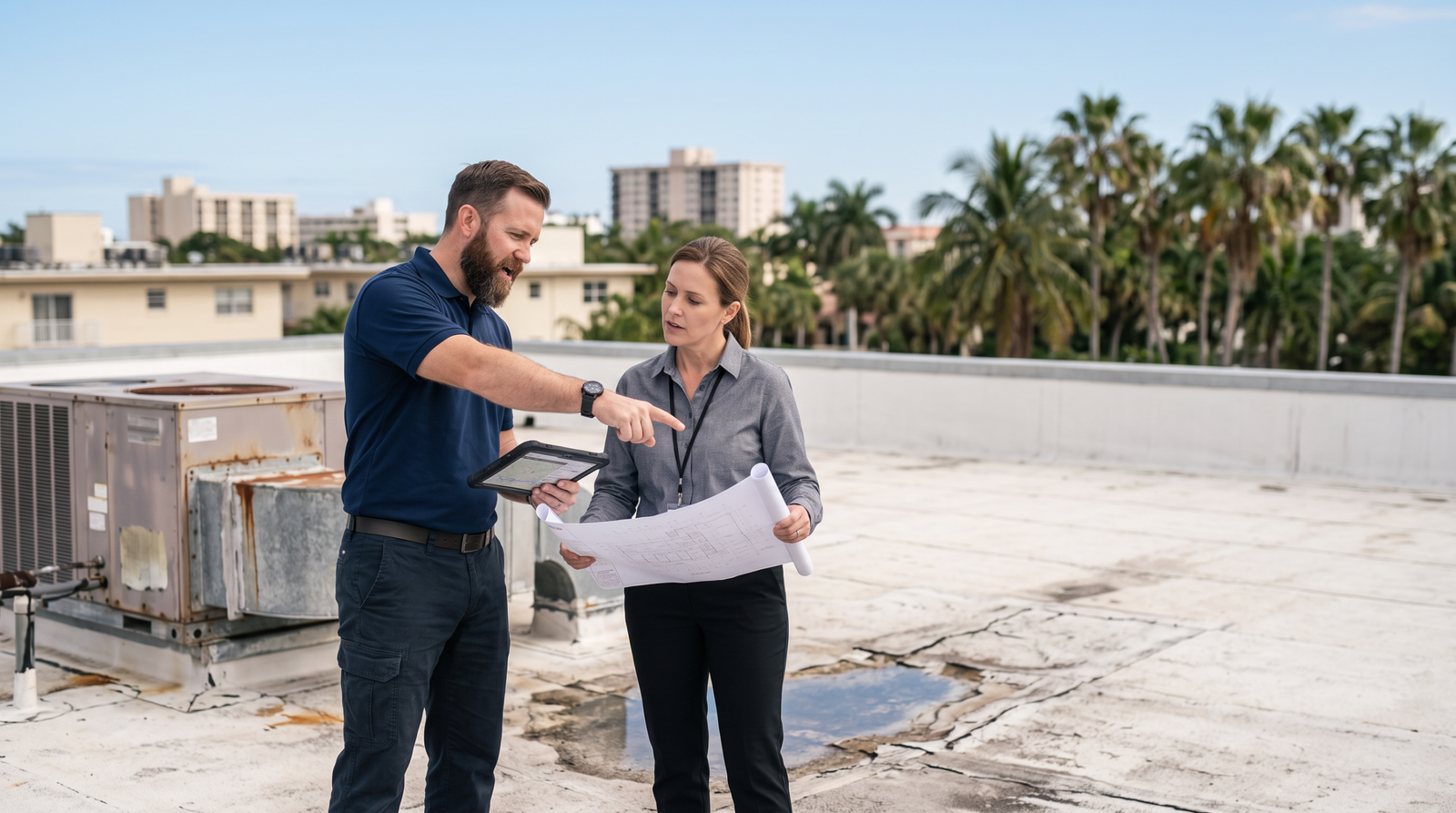
Water accumulation may increase exposure at vulnerable details. Engineers review drainage pathways, accessible outlets, slopes, and evidence of recurring ponding.
The options should be evaluated for how they address the drainage concern. Replacing a covering without considering the configuration may leave the same exposure condition in place.
Drainage capacity or compliance questions may require calculations and design review beyond a visual assessment.
7. Prior Repairs, Overlays, and Alterations
Earlier work can affect the assembly and help explain recurring problems. Engineers review available records and accessible patches, coatings, overlays, equipment changes, and new penetrations.
Repeated repairs may indicate an unresolved source, a recurring detail, or broader deterioration. They do not automatically establish that full replacement is required.
A proposed recover or overlay is a distinct option from removal and replacement. Its feasibility requires evaluation of the existing assembly, concealed conditions, attachment, loading, and applicable project requirements.
8. Requirements Relevant to the Proposed Work
Repair and replacement options may involve different design, permitting, and installation requirements. The applicable review depends on location, existing conditions, system type, and the work proposed.
Engineers identify when further code or design evaluation is needed. A condition assessment does not automatically establish every requirement for construction.
Requirements should be verified for the actual project before an option is treated as ready for implementation.
When Targeted Repair May Be a Supportable Option
A targeted repair may be appropriate when the source and affected area are sufficiently understood, the surrounding assembly remains suitable, and the repair can address the mechanism without leaving related damage unresolved.
The evaluation should explain the scope needed, integration requirements, and remaining limitations. Some repairs require detailed design or verification after completion.
Repair can form part of a phased plan, but the owner should understand what the work addresses and what conditions will remain for future evaluation or action.
When Broader Work or Replacement May Warrant Consideration
Replacement may warrant evaluation when deterioration is widespread, concealed materials are extensively affected, repeated system conditions limit repair performance, or integration of localized work is impractical.
The recommendation should explain why a broader scope is technically appropriate. It should also identify whether roof edges, penetrations, drainage, deck areas, or adjoining envelope components need work beyond the covering itself.
Where the evidence does not establish extent, additional investigation may be needed before selecting between partial replacement, full replacement, or another option.
Florida Wind, Weather, and Code Considerations
Florida exposure may inform evaluation of wind-related conditions, drainage demands, moisture, and coastal deterioration. The relevance depends on the roof system and documented history.
Reported wind damage may prompt review of displacement, attachment, and prior conditions. Heavy rainfall can highlight drainage or transition concerns. Neither exposure nor a reported storm establishes the required replacement scope by itself.
Code and permitting considerations should be tied to the jurisdiction and proposed work. Project-specific requirements should be verified during the appropriate design review rather than assumed from a general condition assessment.
Engineering Findings and the Owner’s Business Decision
Engineering findings help owners understand technical feasibility, expected performance, and unresolved risks. They are one part of the decision.
Owners and asset managers also consider:
- Initial cost and longer-term maintenance expectations
- Tenant and operational disruption
- Access to equipment and sensitive spaces
- Scheduling and temporary weather protection
- Warranty terms and contractor proposals
- Ownership horizon and capital plans
Cost comparisons are more useful when proposals address comparable scopes and disclose exclusions. A lower price may reflect different quantities, concealed-condition assumptions, or omitted details.
The engineering evaluation should make the technical differences clear so business priorities can be applied to supportable options.
What a Useful Evaluation Should Deliver
Depending on the scope, reporting may include:
- Existing system description and areas evaluated
- Photographs and mapped distress
- Supported causes and extent findings
- Compatibility and integration considerations
- Concealed moisture or structural questions
- Technical factors affecting corrective options
- Limitations and recommended further work
Detailed cost estimates, specifications, design documents, construction support, and post-repair testing should be defined when needed. Preliminary findings should not be treated as a complete construction scope if important questions remain.
Preparing to Compare Options
Provide roof records, leak logs, prior repair scopes, dated photographs, and available proposals. Explain the decision timeline, operational constraints, and intended use of the findings.
Identify which options are being considered and where the proposals differ. Engineers can then determine what additional information is needed to evaluate the technical assumptions.
Document conditions before repairs where practical. Necessary measures to limit ongoing damage should proceed, with records retained to show site changes.
Discuss a Commercial Roofing Evaluation
Prema Consulting Group provides engineering input on condition, extent, compatibility, substrate and deck issues, drainage, and code-related considerations that help owners evaluate repair and replacement options.
Our team supports commercial owners, property and facility managers, and asset managers with documented observations and technical analysis to inform corrective planning and investment decisions.
Contact Prema to discuss a commercial roofing evaluation for your property
Frequently Asked Questions
Does a leaking roof always need replacement?
−No. A localized condition may be repairable when its source, extent, and surrounding assembly are understood. Broader deterioration may require evaluation of larger corrective options.
What engineering factors affect roof repair versus replacement?
+Factors include cause, extent, existing condition, compatibility, concealed moisture, deck concerns, drainage, prior work, and requirements applicable to the project.
Does engineering determine the final business decision?
+Engineering informs technical feasibility and limitations. Owners also consider cost, operations, scheduling, warranties, and asset plans.
Is a roof overlay the same as replacement?
+No. An overlay or recover retains existing materials, while removal and replacement involves a different scope. Feasibility and requirements must be evaluated for the proposed approach.
Can the assessment identify a need for more testing?
+Yes. Additional testing or access may be needed when concealed conditions or uncertain extent could materially change the option selected.
Our Related Services
Need Expert Forensic Engineering & Building Assessment Insights?
Get our accurate, evidence-based analysis to identify root causes, assess structural integrity, and make confident decisions.
Get in Touch →