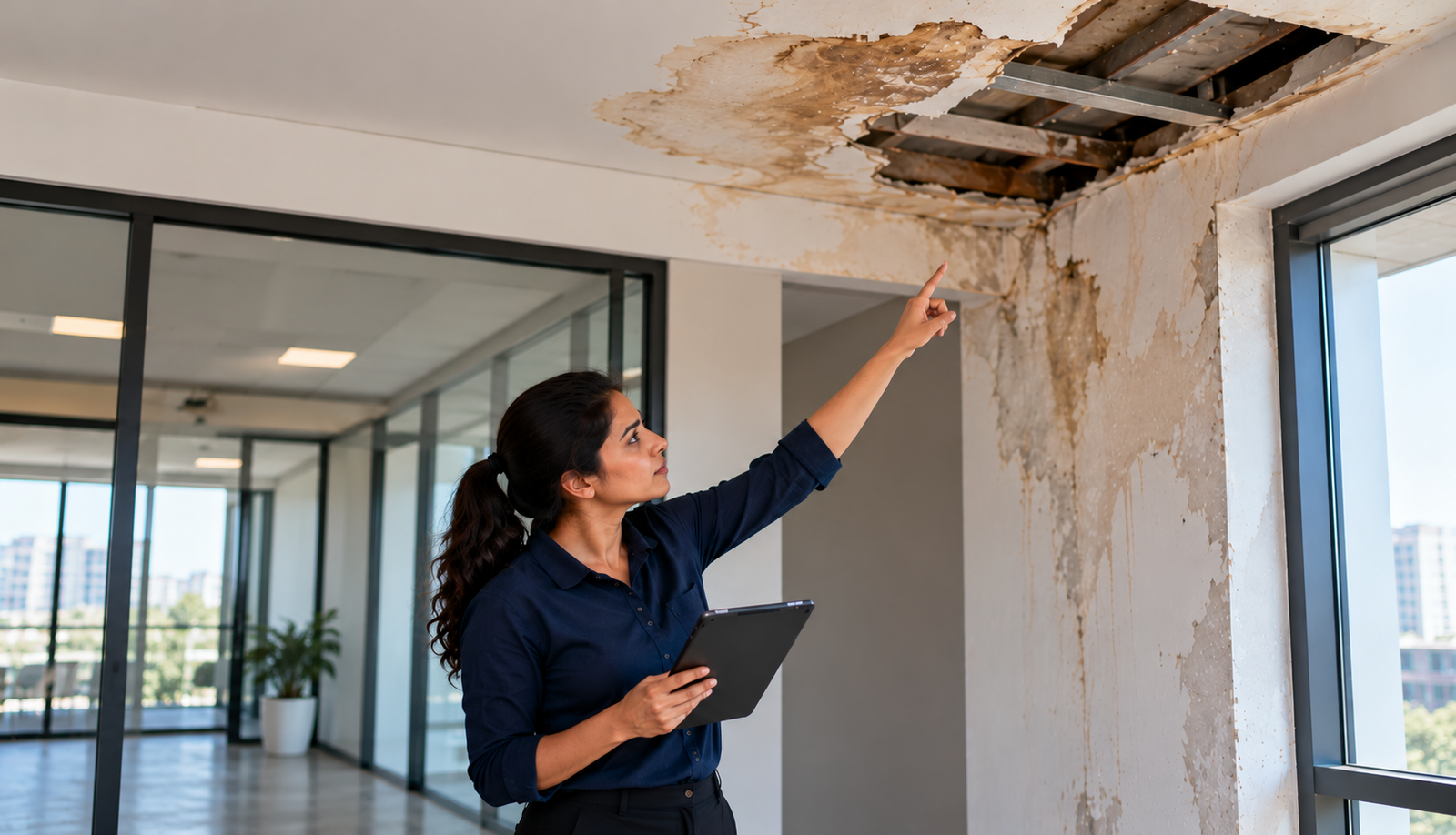
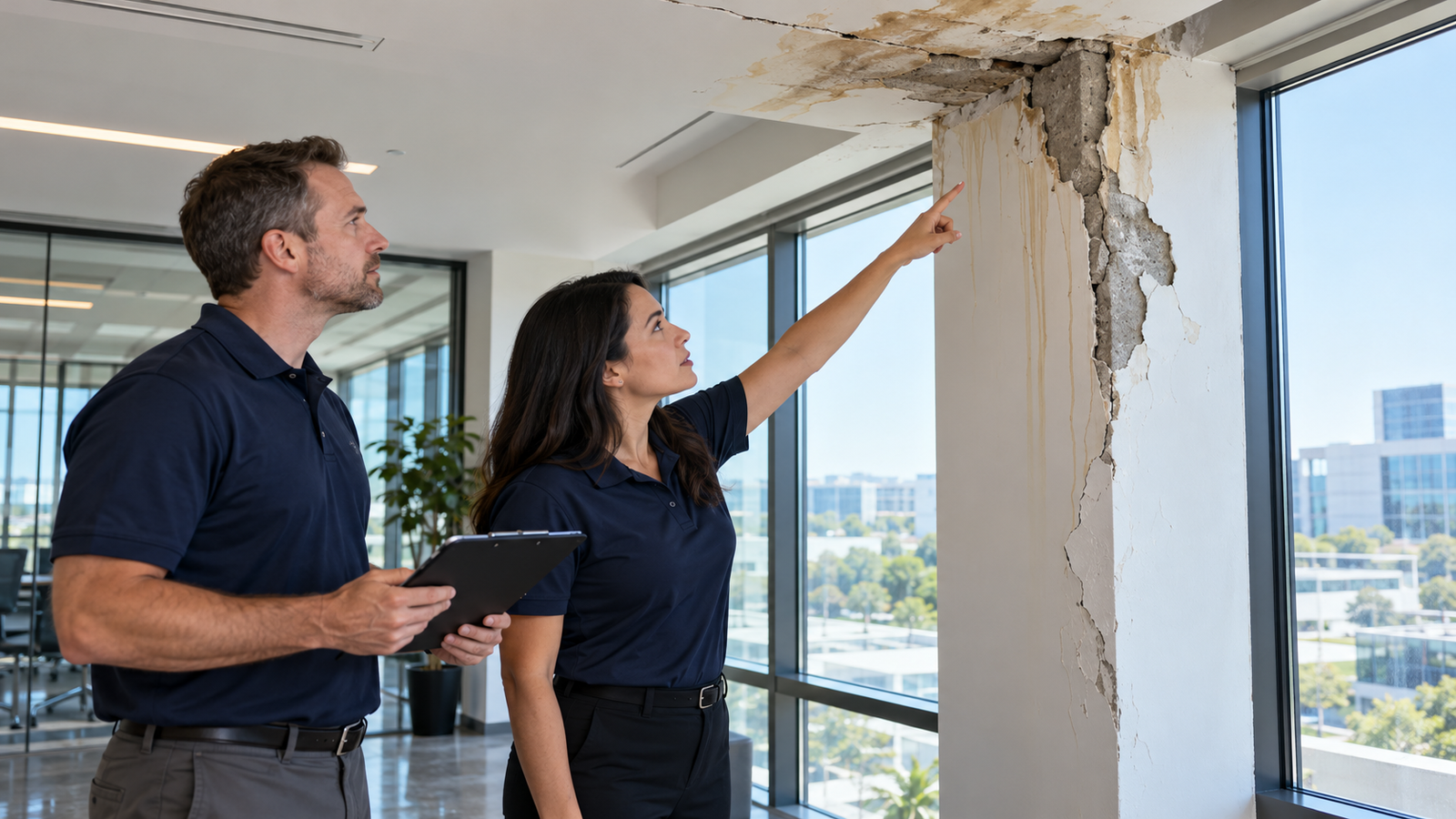
Florida commercial property claims may involve roof leakage, water staining, concrete deterioration, or structural distress. These observations can prompt questions about construction quality, but they do not establish a defect on their own.
For insurance professionals researching common construction defects in Florida, the useful distinction is between the reported symptom, a suspected deficiency, and a supported cause of damage.
A forensic engineering investigation evaluates specific building details, relevant records, and competing explanations. The examples below illustrate conditions that may warrant review; they are not a ranking of defect frequency or findings about a particular property.
Distinguishing Building Damage From a Construction Defect
A construction defect investigation may assess suspected deficiencies in design, materials, or installation and their relationship to building performance.
Engineers first document the physical condition. They then compare relevant details with available project documents, applicable installation instructions, and technical requirements relevant to the work.
For example, water staining identifies an affected area. It does not establish the entry point or demonstrate deficient installation. Similarly, a concrete crack does not establish improper construction without evaluation of its pattern, location, behavior, and surrounding conditions.
Six Building System Conditions That May Warrant Investigation
- Roofing Attachment, Flashing, and Termination Details
Reported roof leakage or displaced materials may prompt examination of:
- Roof covering attachment and accessible fasteners
- Flashing at penetrations, curbs, and wall transitions
- Edge details and membrane terminations
- Seams, laps, and prior repairs
Engineers may compare observed details with the specified roof assembly and relevant installation instructions. In Florida, wind and rain exposure may be part of the analysis, depending on the property and reported event.
The investigation must distinguish suspected installation deficiencies from storm effects, material aging, maintenance conditions, and later alterations. Leakage or displacement alone does not establish which explanation applies.
- Window and Exterior Wall Interfaces
Water intrusion near windows or exterior walls may involve several interconnected details.
Engineers may evaluate:
- Flashing and water management at openings
- Sealant joints and transitions between materials
- Connections between window and wall assemblies
- Accessible drainage paths within the assembly
Staining below a window may originate at the window, an adjacent wall transition, or another location. The analysis should trace supported pathways rather than assume that the visible stain identifies the source.
Selective openings or targeted testing may be needed when the relevant details are concealed or more than one explanation remains plausible.
- Waterproofing at Elevated Decks and Transitions
Leakage beneath an elevated deck, terrace, or similar area may warrant review of waterproofing continuity and adjoining details.
Potential evaluation areas include:
- Waterproofing transitions at walls and thresholds
- Penetrations and drain interfaces
- Joints and movement details
- Previous repairs or surface modifications
Engineers evaluate the observed construction in relation to the intended assembly and available product requirements. Surface leakage symptoms may not reveal the concealed condition responsible for the reported damage.
The investigation may need to distinguish waterproofing deficiencies from deterioration, damaged joints, blocked drainage, or changes made after construction.
- Roof Drainage and Water Management
Standing water or repeated overflow can raise questions about how water is collected and discharged.
Engineers may examine:
- Roof slopes and drain locations
- Accessible primary and secondary drainage provisions
- Drain obstructions and maintenance history
- Changes to roofing or drainage components
Available drawings, measurements, and records help establish whether the observed configuration differs from the intended design and whether that difference relates to the reported condition.
Standing water alone does not establish a construction defect. Drain blockage, later modifications, or other property-specific factors may contribute and should be evaluated.
- Structural Connections and Framing Modifications
Structural distress or changes to a commercial building may prompt examination of how loads move through framing and connections.
Examples include:
- Connection details that differ from available drawings
- Openings added through structural components
- Removed or modified framing
- Equipment added to roofs or floors
Engineers evaluate the component’s role, relevant loads, and interaction with adjacent members. A modification is not automatically deficient; the investigation considers its documented design and effect on the structural system.
Visible cracking or deformation may require further analysis to determine whether it is related to the suspected detail or another mechanism.
- Concrete Placement and Reinforcement Protection
Cracking, spalling, or exposed reinforcement may prompt questions about original construction as well as later deterioration.
Engineers may evaluate:
- Accessible evidence of consolidation or placement conditions
- Reinforcement location and concrete cover where measurable
- Crack patterns and surrounding distress
- Reinforcement condition and exposure history
Relevant drawings, measurements, and testing may help assess a suspected deficiency. Corrosion or spalling alone does not establish inadequate concrete cover or improper placement.
Coastal exposure, moisture pathways, aging, and prior repairs may also be relevant. The analysis should connect any identified construction condition to the deterioration mechanism supported by the evidence.
Other Factors Engineers Must Consider
Building performance can change over its service life. A neutral investigation evaluates factors beyond original design and installation, including:
- Maintenance and inspection history
- Material aging and environmental exposure
- Reported storms or other external events
- Repairs and alterations
- Changes in building use or loading
These factors may contribute to damage, interact with a suspected deficiency, or provide alternative explanations. Their presence should be evaluated rather than automatically classified as a construction defect.
How Florida Exposure Informs the Evaluation
Florida exposure conditions can provide context for specific technical questions. Wind-driven rain may be relevant to envelope pathways, coastal exposure to corrosion, and heavy rainfall to drainage performance.
Exposure alone does not establish a deficiency, its cause, or when damage developed. Engineers evaluate the property’s location, construction, condition, and available event history together.
A condition discovered after a storm is not automatically attributable to that storm. The investigation should explain which relationships the evidence supports and where timing remains uncertain.
How Engineers Evaluate Suspected Construction Deficiencies
Document Conditions and Review Records
Engineers document accessible details and review available plans, specifications, approved revisions, installation instructions, inspection records, and repair history.The report should distinguish field observations from reported information and identify missing records that affect the analysis.
Compare Construction With Relevant Criteria
The comparison should identify the particular detail or requirement being assessed and its relevance to building performance. Requirements must be considered in the context of the original work or subsequent modification.
A departure from a documented requirement does not, by itself, establish that it caused the reported damage. Engineers evaluate whether and how the condition contributed.
Use Additional Access or Testing When Needed
Depending on the assignment, selective openings, targeted water testing, material evaluation, or structural analysis may help answer unresolved questions.
The scope should define the purpose of additional work and its limitations. Concealed conditions should not be treated as confirmed when they have not been evaluated.
Establish Documented Extent
Findings should reflect the locations inspected and the evidence obtained. When representative locations are evaluated, the report should explain their selection and the limits of applying those findings elsewhere.
Similar symptoms do not automatically establish identical concealed conditions throughout a building. Additional investigation may be needed to assess broader extent.
What the Findings Should Help Claims Professionals Understand
A useful engineering report addresses:
- What physical conditions are documented
- Whether the evidence supports a suspected deficiency
- How the condition relates to reported damage
- Which other explanations were evaluated
- What extent is established and what remains concealed
- Whether further access, testing, or specialist input is needed
The report should explain its technical basis, assumptions, and unresolved questions. Engineering findings inform claim review but do not independently determine coverage or legal responsibility.
Repair design, when needed, requires a defined scope beyond documentation and causal analysis alone.
Discuss an Assignment With Our Forensic Engineering Team
Prema Consulting Group evaluates suspected roofing, envelope, drainage, concrete, and structural deficiencies in Florida commercial property investigations.
Our forensic engineering team provides insurance professionals with documented observations and technical findings addressing physical cause, contributing factors, documented extent, and investigation limitations within the agreed scope.
Contact Prema to discuss a Florida commercial construction defect investigation assignment.
Frequently Asked Questions
What potential construction defects may be evaluated in Florida commercial buildings?
−Investigations may assess suspected deficiencies in roof details, exterior wall interfaces, waterproofing, drainage, structural connections, and concrete construction. These are examples of evaluation areas, not confirmation that a particular building has a defect.
Does leakage or concrete deterioration establish a construction defect?
+No. Engineers evaluate the observed condition, relevant construction details, available records, and alternative explanations before drawing conclusions about a suspected deficiency and its relationship to damage.
How does Florida exposure influence the investigation?
+Wind, rain, moisture, and coastal exposure may be relevant to specific damage mechanisms. The evaluation considers the property’s actual exposure and evidence rather than assuming a cause based on location.
Can findings from a limited inspection be applied to the entire building?
+The report should explain the inspection scope and the basis for any broader interpretation. Uninspected or concealed conditions may require additional investigation before their extent can be established.
Our Related Services
Need Expert Forensic Engineering & Building Assessment Insights?
Get our accurate, evidence-based analysis to identify root causes, assess structural integrity, and make confident decisions.
Get in Touch →