

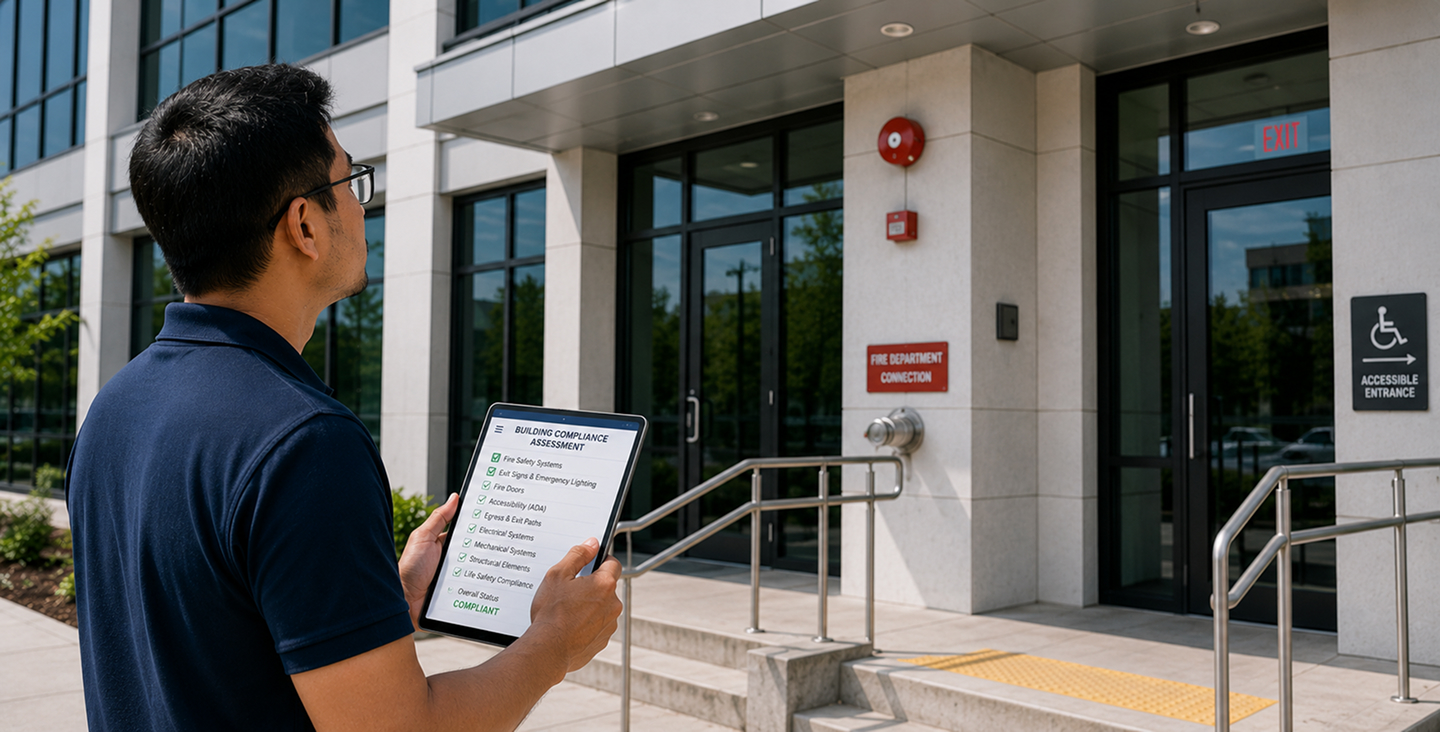
Building Compliance Assessments Explained
We were contacted by a property owner a few months ago who believed his building was compliant. He felt good about the fact that he had recently passed an inspection, his documentation was in order, and there had been no changes for many years. In reality, he had not tested his fire suppression systems in more than ten years to meet the proper codes, and the accessible pathway to his main entrance did not comply due to resurfacing of his parking lot.
That is one of the reasons that code compliance is not constant. The codes change, buildings deteriorate, additions and renovations occur without consideration of the compliance of the entire structure. A building may be perfectly fine for people to occupy but still be non-compliant in certain respects.
What a Compliance Assessment Actually Covers
People sometimes assume this is just a fire marshal walking through with a checklist. It’s broader than that. A proper assessment looks at structural elements, fire and life safety systems, accessibility requirements under ADA, electrical and mechanical systems, egress paths, and anything else tied to local building codes and occupancy classifications.
The scope depends heavily on the building type and how it’s used. A restaurant has different requirements than a warehouse. When a building changes what it is used for like from a store to a place with homes, it can have some problems that nobody fixed. This is because nobody had to fix them when the building was changed. The people who check the building go through each part of it carefully. They compare what is really there to what the rules say should be there for that kind of building. They do this for each system in the building to make sure it is safe for the people who live or work there. The rules they use are the rules for buildings like that, with homes upstairs and stores or offices downstairs.
Why Compliance Inspection Isn’t a One-Time Event
A lot of owners treat their last compliance inspection as permanent proof that everything’s fine. It isn’t. Codes get revised on a cycle, usually every few years, and a building that met every requirement at the time it was built or last renovated can fall out of compliance simply because the standards moved and the building didn’t.
You have to think about all the things that can go wrong with fire safety equipment over time. Fire doors are often propped open, which means the self-closing mechanism will eventually stop working. Sometimes during maintenance work, sprinkler heads get painted over. The lights on exit signs can burn out. It may take a while to replace them. These things do not all happen at the same time. They happen slowly one by one. That is why it is really important to check everything. This is the way to catch problems with fire doors, sprinkler heads and exit signs before they become big issues. If you do not do this, you might fail an inspection. Have an insurance claim denied or something even worse could happen with fire doors and other safety equipment.
Where Compliance Gaps Tend to Show Up
Certain areas come up again and again. Accessibility is an issue. We have ramps that used to be okay when they were first put in. Now they do not meet the slope requirements because the surface was redone. The hardware on doors is also a problem because it is too hard to turn or pull open. Then there are the restrooms, where the space between things got smaller when they were remodeled; more things could fit in the same area. Accessibility issues, like these need to be fixed.
Fire and life safety is another recurring area. Egress paths that got partially blocked by storage or furniture over time. Fire-rated doors that were replaced with standard doors during a maintenance job because nobody realized the rating mattered. Emergency lighting that’s never been tested since installation.
Electrical systems are a problem too. This is especially true in buildings. You see, in buildings people often upgraded the electrical panels a little bit at a time, over the years. They did not do it all once as a big project. Sometimes the papers do not match what is really there. The permit record says one thing. The electrical system is actually something else. This becomes an issue when an inspector or insurance adjuster looks at the papers and the electrical system. They will notice that the papers and the electrical system do not match. Electrical systems and permit records are supposed to match. With electrical systems, this is not always the case.
The Real Cost of Skipping This
Owners sometimes push back on scheduling an assessment because it feels like an expense without an obvious return. That calculation changes fast once something goes wrong. A failed fire inspection can shut down operations until it’s corrected. A denied insurance claim after a fire or injury, because the building wasn’t actually up to code despite looking fine on paper, can cost far more than any assessment ever would have. Liability exposure after an accessibility complaint or an injury tied to a code violation tends to dwarf whatever the assessment would have cost to prevent it.
There’s also the practical reality of selling or refinancing a property. Lenders and buyers increasingly want documentation showing a building has been assessed and any gaps addressed, especially for commercial properties. Walking into that conversation with a clean assessment already in hand puts an owner in a much stronger position than scrambling to explain violations after they’ve already been flagged by someone else.
What the Process Looks Like
Most assessments start with a records review, pulling permits, prior inspection reports, and any renovation history to understand what’s supposed to be in place. From there, it moves to a physical walkthrough covering every relevant system, documented with photos and notes tied to the specific code sections involved.
The output is a report that doesn’t just list problems but prioritizes them. Life-safety issues get flagged as urgent. Cosmetic or lower-risk items get noted with a reasonable timeline for correction. A good report also gives the owner enough detail to actually act on it, not a vague summary that leaves them guessing what needs to happen next.
Who Actually Needs One
Any commercial property owner benefits from this on a regular cycle, but a few situations make it especially worth prioritizing. Buying an existing building, since compliance issues discovered after closing become the new owner’s problem, not the seller’s. Renovating or changing a building’s occupancy classification, since that’s exactly when compliance requirements shift. Operating in an industry with heightened liability exposure, like healthcare or hospitality, where a missed requirement carries bigger consequences if something goes wrong.
Property managers overseeing multiple buildings also tend to build this into a rotating schedule, checking a portion of their portfolio each year rather than letting any single property go too long without a fresh look.
Choosing Who Actually Does the Assessment
Not every inspector or consultant offering compliance services has the same depth of expertise, and this is a place where cutting corners on who you hire tends to show up later. A general contractor doing a walkthrough might catch obvious issues but miss the kind of nuanced code interpretation that a licensed engineer or a specialist in a particular code area would catch immediately.
You should ask what codes and standards the assessment covers. You should also ask if the person doing the assessment has experience with your building type and occupancy classification. It is also important to ask if the report will be good enough if you need to use it for an insurance claim or a legal dispute. A report that just says your building looks fine is not very useful. This is because if something goes wrong with your building six months later you will need to know what was actually checked. The assessment and the report need to be detailed so they can be used later if needed. You need to make sure the report, from the assessment of your building will be useful if you need it later.
How This Fits Into Ongoing Building Management
A single assessment is useful.. The real value of an assessment comes from doing it over and over. This means an assessment is not something you do when you have a problem. It is something you do all the time.
For example, buildings that get assessed every year are better off. They also get frequent checks on fire systems and life safety systems. This helps them find problems before they become big and expensive problems. Regular assessments of buildings and their systems, like fire and life safety systems, are very important.
This is especially true for owners managing multiple properties. Building a rotating schedule where each property gets a fresh assessment every few years means nobody’s operating on assumptions that are a decade out of date, and nobody’s caught off guard by a code cycle change they didn’t know was coming.
Getting Ahead of It
The building owner, from the beginning of this article, ended up spending less fixing the issues we found than he would have paid in fines and downtime if the fire marshal had caught them during a routine inspection instead. That’s usually how it plays out. A building compliance assessment costs a fraction of what a failed inspection or a liability claim costs, and it puts the owner in control of the timeline instead of reacting to someone else’s deadline.
If it’s been a while since your property had a real look-over, or you’re not entirely sure what’s changed in your local codes since your last renovation, it’s worth getting ahead of it rather than finding out the hard way. Compliance Assessment Services can walk your property system by system and give you a clear picture of where things actually stand.
Recent Blogs




Our Related Services
Need Expert Forensic Engineering & Building Assessment Insights?
Get our accurate, evidence-based analysis to identify root causes, assess structural integrity, and make confident decisions.
Get in Touch →