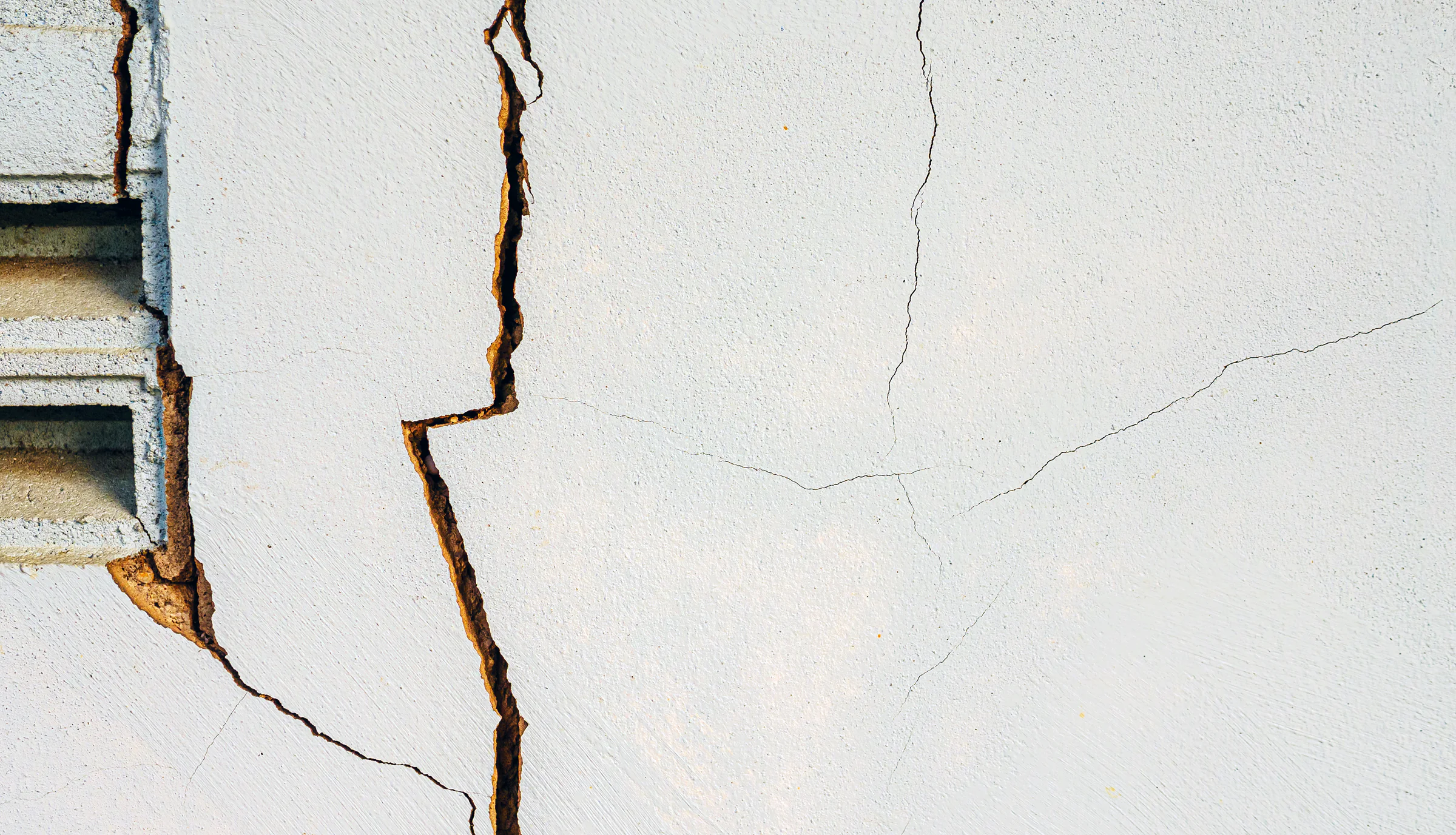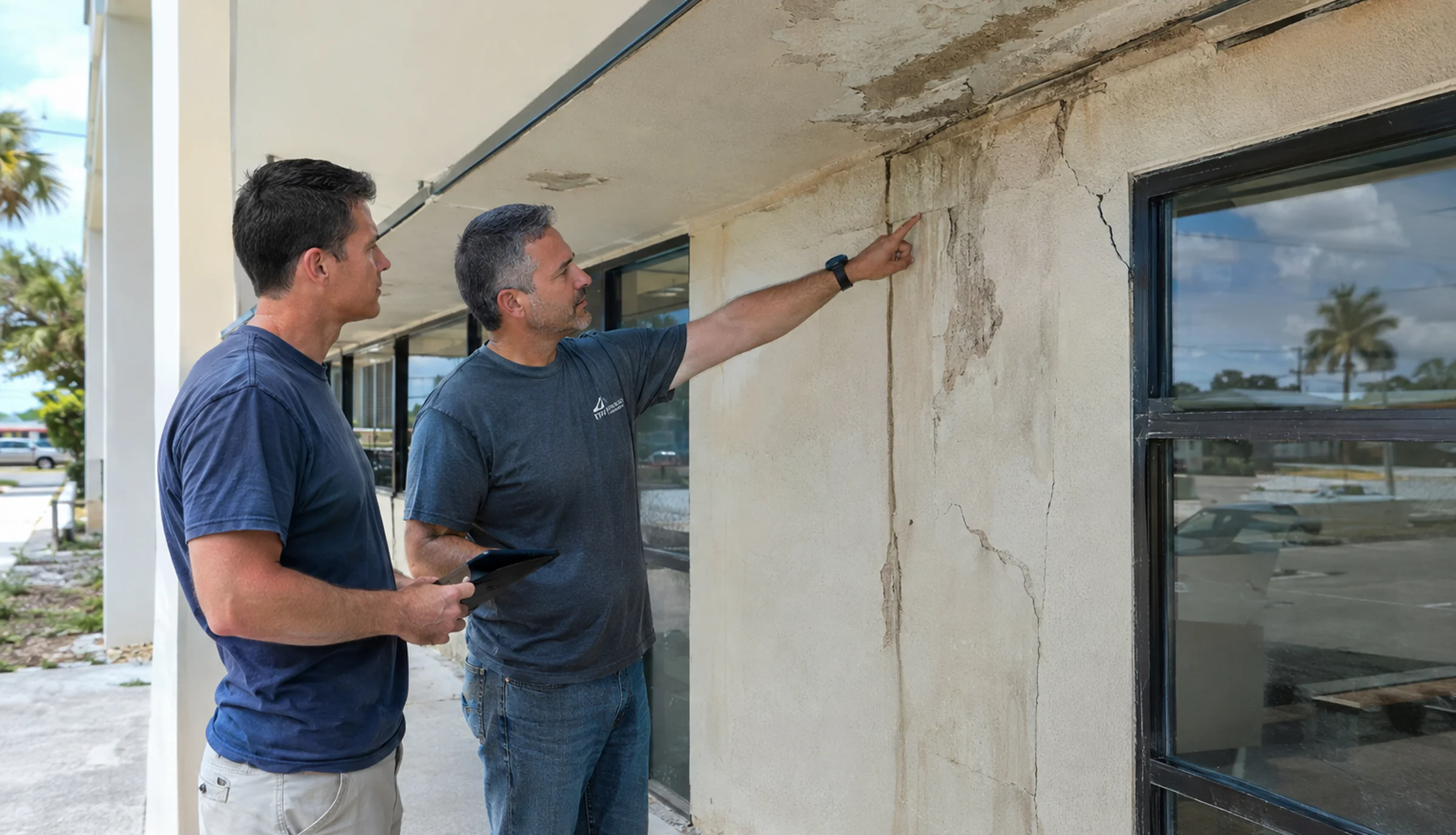
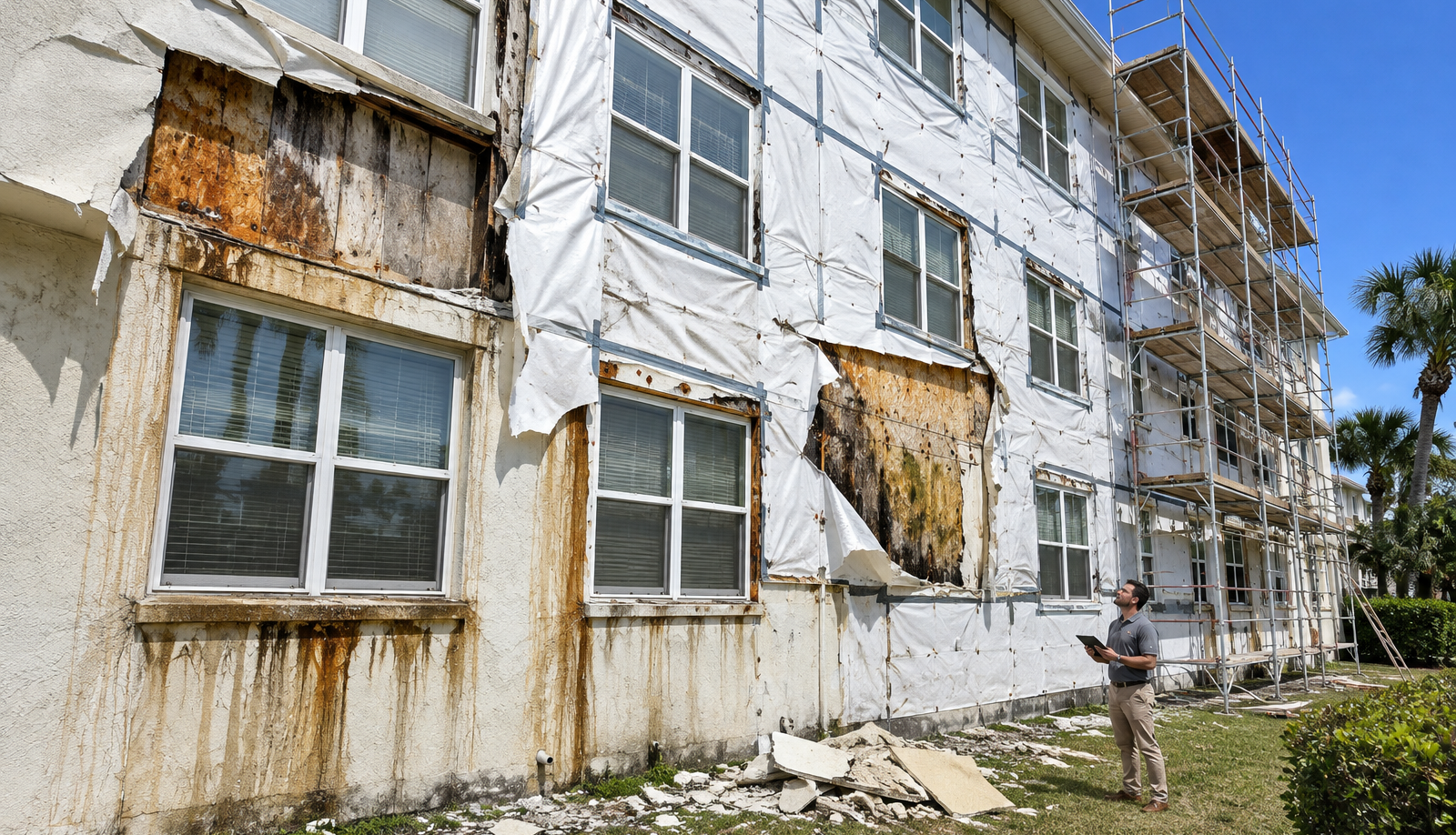
Water intrusion, staining, and deterioration near exterior assemblies may raise questions about building envelope construction defects. These symptoms alone do not establish a deficiency or identify the water entry point.
For claims professionals, the investigation should explain which components are involved, what mechanisms the evidence supports, and what remains unresolved. The central task is connecting observed construction conditions to reported damage through documented evidence.
A forensic engineering evaluation examines building details, available records, and other potential explanations to assess physical cause and documented extent within the assignment scope.
What Are Building Envelope Construction Defects?
The building envelope separates interior spaces from exterior conditions. Its components include exterior walls, roofs and roofing interfaces, windows and doors, flashing, waterproofing, sealants, and related assemblies that manage environmental exposure.
A construction defect investigation may assess suspected deficiencies in design, materials, installation, or detailing and their effect on intended performance.
Conditions that may warrant investigation include:
- Flashing details that differ from available project documents
- Discontinuities at waterproofing transitions
- Sealant or joint conditions associated with leakage
- Window and door installation concerns
- Drainage paths that appear obstructed or incomplete
- Wall assembly conditions and exterior penetrations
These observations require evaluation in context. Aging, exposure, maintenance, and subsequent repairs or alterations may also contribute to reported damage.
Building Envelope Conditions That May Warrant Investigation
Water Intrusion at Building Transitions
Roof-to-wall interfaces, window openings, deck transitions, and penetrations connect assemblies with different functions and materials.
Engineers may examine:
- Continuity of water management details
- Integration of flashing and adjacent assemblies
- Joints and movement between materials
- Repairs or changes at the interface
The investigation evaluates whether a specific detail contributed to the supported water pathway rather than assuming that any irregularity caused the reported damage.
Flashing and Waterproofing Concerns
Flashing and waterproofing help manage water at vulnerable areas. Suspected deficiencies may involve their placement, continuity, termination, or integration with adjoining components.
Engineers compare accessible details with relevant documents and installation requirements. Concealed portions may require additional access before their condition can be established.
The evaluation also considers deterioration, exposure, and later modifications that may explain performance independently of original construction.
Sealant and Joint Conditions
Deteriorated or separated sealant describes an observed condition; it does not establish its cause.
Relevant considerations may include:
- Joint configuration and anticipated movement
- Substrate condition and preparation
- Material compatibility
- Accessible evidence of installation details
- Exposure, maintenance, and repair history
Engineers evaluate whether the joint condition relates to the documented leakage pathway and whether installation, aging, movement, or another mechanism is supported.
Window and Door Interfaces
Windows and doors, often referred to as fenestration, must work with surrounding wall assemblies and water management details.
Investigation may address:
- Perimeter joints and flashing
- Connections with adjacent wall components
- Accessible drainage features
- Conditions within or around the unit
The complete interface may need evaluation. Visible damage near an opening does not, by itself, establish that the window or door is the source.
Entry Point, Water Pathway, and Damage Location
Water may travel within an assembly before visible damage appears. Engineers evaluate three related questions:
- Where did water enter?
- How did it travel through the building assembly?
- Where did it affect materials or become visible?
For example, staining below a window may result from entry at the window interface, an adjacent wall transition, or another location. The investigation assesses the potential entry point and travel pathway separately from the visible damage location.
This approach helps distinguish a supported mechanism from an assumption based only on the position of a stain.
How Engineers Evaluate Suspected Envelope Deficiencies
Step 1: Review Available Information
Useful records may include:
- Plans, specifications, and approved revisions
- Manufacturer installation instructions relevant to the assembly
- Construction photographs and inspection records
- Prior evaluations and testing results
- Maintenance, repair, and alteration history
- Dated photographs and reported damage chronology
Engineers distinguish documented evidence from reported information and identify missing records that may limit the analysis.
Step 2: Document Accessible Conditions
Field documentation may include photographs, measurements, location mapping, and observations of affected and comparable areas.
Engineers may record:
- Exterior assembly details and transitions
- Staining, deterioration, and other moisture indicators
- Accessible flashing, joints, and waterproofing
- Prior repairs and surrounding distress
- Components or areas that cannot be accessed
Observations establish conditions present at the inspection. They do not necessarily establish concealed details, prior conditions, or the exact timing of damage.
Step 3: Determine Whether Additional Access or Testing Is Needed
Where relevant details remain concealed or competing explanations cannot be resolved, further work may include:
- Selective openings to examine interfaces
- Targeted water testing
- Moisture measurements
- Material sampling or specialist evaluation
Methods should address specific questions and be coordinated with the appropriate project parties. Conditions should be documented before and during work that alters an assembly.
Each method has limits. A moisture measurement alone does not establish the source or duration of exposure. Testing findings should be interpreted within the tested configuration and conditions.
Suspected concealed conditions should remain distinct from those confirmed through access or testing.
Step 4: Compare Details With Relevant Technical Criteria
Engineers may compare observed construction with available project documents, relevant manufacturer instructions, and requirements applicable to the work being evaluated.
The report should identify the detail or requirement assessed and explain its relevance to performance.
A departure from a documented detail does not, by itself, establish that it caused the reported damage. Engineers evaluate whether and how the condition contributed, while considering reasonable alternative explanations.
Step 5: Assess Cause, Documented Extent, and Timing Evidence
The analysis connects observations, records, and testing results to the supported damage mechanism.
Findings should reflect inspected locations and available evidence. Confirming a concealed condition at one opening does not automatically establish the same condition throughout the building. Representative investigations should explain the selection approach and limits of applying findings elsewhere.
The date symptoms were reported may differ from when an underlying condition originated or deterioration began. A condition discovered after a storm is not automatically attributable to that event.
Where the evidence does not establish broader extent or timing, the report should identify the unresolved question and any additional investigation needed.
Environmental Exposure and Florida Examples
Exposure conditions help inform property-specific questions. In Florida, wind-driven rain may be relevant to leakage pathways, coastal exposure to corrosion, and repeated moisture exposure to deterioration within assemblies.
These factors may interact with a construction deficiency or contribute to deterioration independently. Location or climate alone does not establish cause.
The same investigative approach applies in other regions, with attention to the building’s materials, construction, exposure, and history.
What Claims Professionals Should Expect From the Findings
A useful report should explain:
- The assignment scope and questions evaluated
- Observed symptoms and confirmed construction conditions
- Documents, methods, and testing considered
- Relevant technical criteria
- Supported entry points, pathways, and contributing mechanisms
- Documented damage extent and timing evidence
- Access limitations, assumptions, and unresolved questions
- Recommended further investigation where needed
Engineering findings inform claim review without independently determining coverage or legal responsibility. Repair design and construction-phase services require a defined scope beyond the forensic investigation.
Claims professionals can assist by providing available records, dated photographs, repair history, known access restrictions, and information about planned work that may change the evidence.
Discuss an Assignment With Our Forensic Engineering Team
Prema Consulting Group investigates accessible envelope details and suspected concealed conditions involving flashing, joints, waterproofing, windows and doors, and water management interfaces.
Our forensic engineering team supports claims professionals with documented observations and technical findings addressing supported moisture pathways, contributing factors, documented extent, and investigation limitations within the agreed scope.
Contact Prema to discuss a construction defect investigation assignment.
Frequently Asked Questions
What symptoms may warrant a building envelope investigation?
−Water intrusion, staining, repeated leakage, deteriorated materials, and distress near exterior transitions may warrant evaluation. These symptoms do not, by themselves, establish a construction defect.
Can a forensic engineer assess whether an envelope condition is construction-related?
+An engineer can evaluate observed details against relevant technical criteria and analyze their relationship to reported damage. Findings should explain the supporting evidence, alternative explanations, and investigation limitations
Why can the water entry point differ from the damage location?
+Water may travel through concealed portions of an assembly before affecting materials or becoming visible. The investigation evaluates entry, travel, and damage locations separately.
Does an envelope investigation always require selective openings or testing?
+No. The need depends on the assignment questions and available evidence. Additional methods may be appropriate when details are concealed or observations alone cannot distinguish between possible mechanisms.
Our Related Services
Need Expert Forensic Engineering & Building Assessment Insights?
Get our accurate, evidence-based analysis to identify root causes, assess structural integrity, and make confident decisions.
Get in Touch →