

Building Collapse Investigations Explained
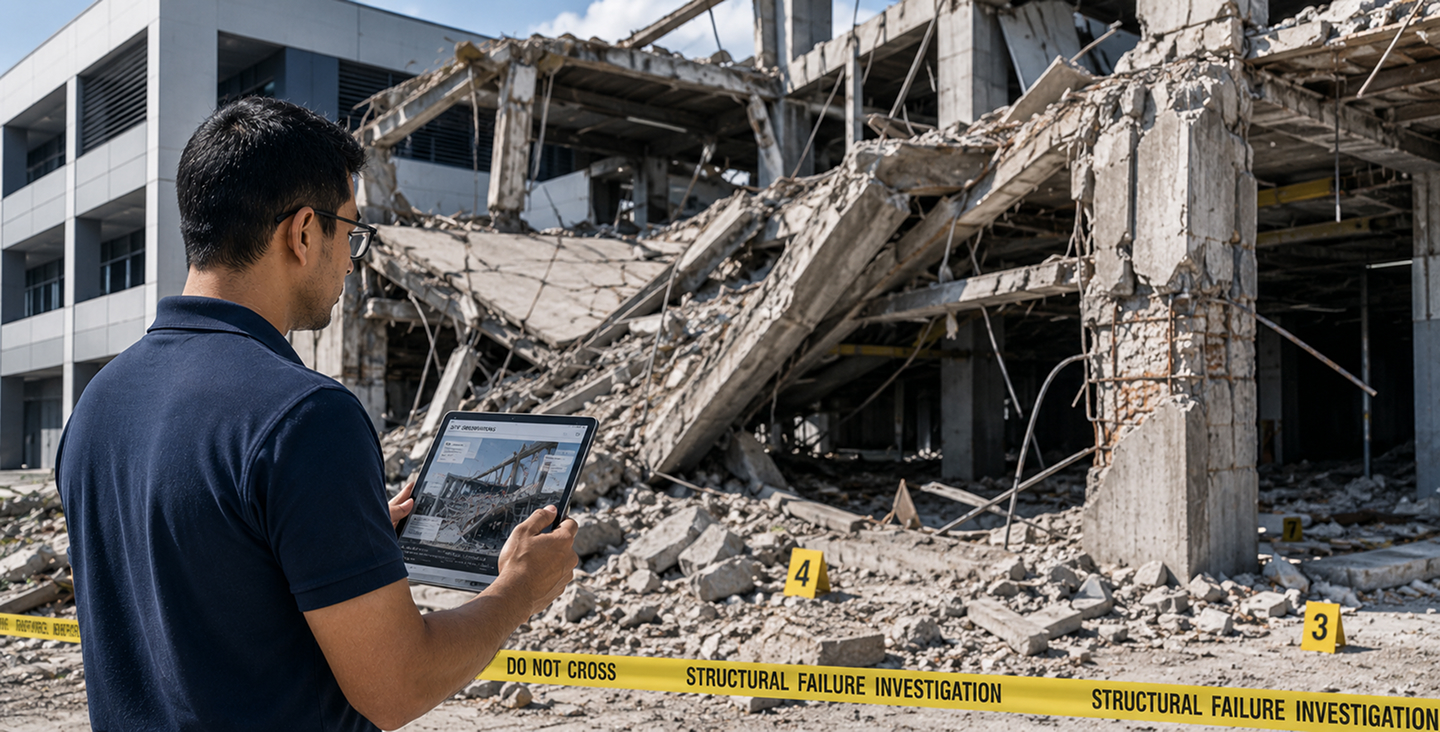
The call usually comes in fast. A parking garage floor gives way at 2 a.m., or a section of roof over a retail space folds in on itself during a snow event, and within hours there are fire crews, structural engineers, sometimes OSHA, all standing at the same perimeter tape trying to figure out who does what first. Nobody’s thinking about paperwork in that moment. But paperwork, or more precisely documentation, is exactly what decides how the next six months of the investigation go.
I’ve talked to engineers who’ve worked these scenes, and one thing comes up again and again: the first 48 hours matter more than almost anything that happens afterward. Evidence gets buried under debris removal, weather washes away material properties, and memories of what people saw start drifting the moment they walk away from the site. A forensic engineering investigation into a collapse isn’t really one investigation. It’s several running in parallel — life safety, evidence preservation, and root cause — and they don’t always agree on priorities.
Securing the Scene Comes Before Anything Else
Before you can really look at a site, you have to figure out if it’s safe to go inside. This seems like a no-brainer. It is not that simple. If a building has partly fallen down, the rest of the building might still be shaky. So if you send an engineer to take pictures before you have made the site safe, that is not being careful; that is just asking for another accident to happen at the site. You have to think about the site and whether it’s safe for people to be, at the site.
Life safety officials usually control access first. Once the immediate danger is addressed, the site gets treated almost like a crime scene, because in a legal sense it kind of is one. Fencing goes up. Access gets logged. Anyone who touches debris, moves a beam, or even walks across a specific section gets noted, because six months later a lawyer is going to ask exactly who was where and when.
Documenting the Wreckage Before It Gets Touched
This is where things get slow and, frankly, tedious. Every piece of debris that might matter gets photographed in place before it’s moved. Not just close-up shots of a fractured connection — wide shots too, showing where that piece sat relative to everything around it. Numbers, tags, sometimes spray paint directly on debris pieces to keep track of what came from where.
Drones have made a real difference here. A collapsed roof structure from above tells you things a ground-level photo never will — the overall collapse pattern, whether failure started at one point and spread, or happened more or less everywhere at once. That distinction alone can point an investigation in a completely different direction.
Why Sequence Matters More Than People Assume
One of the harder things to reconstruct after a collapse is the order things happened in. Did a single connection fail first, sending load onto neighboring members that then failed in a chain? Or did something more uniform happen, like an entire deck losing capacity all at once because of a material issue affecting the whole pour?
Debris patterns actually hold clues to this. A progressive collapse tends to leave a kind of cascading footprint, material piled in a direction that suggests one section pulling down the next. A more uniform failure often leaves debris that’s flatter, more evenly distributed, without that same directional bias. Reading that pattern correctly, right at the start, saves weeks of analysis later.
Pulling the Paper Trail
While the physical site work happens, a separate track of the investigation is digging through records. Permit history. Original structural drawings. Any changes made during construction — change orders, RFIs, field modifications that never made it back onto the as-built set. Inspection reports, if any exist. Maintenance logs, especially for anything involving corrosion protection, waterproofing, or load-bearing repairs done after the original construction.
This part sounds boring compared to standing on a collapsed structure with a drone overhead, but it’s often where the real answer lives. A collapse that looks, on the surface, like a sudden material failure sometimes traces back to a design change made eight years earlier that nobody flagged as a structural issue, because at the time it didn’t seem like one.
Material Testing and Lab Work
Samples get pulled from the wreckage, steel, concrete, welds, connectors, whatever’s relevant to the suspected failure mode, and sent out for testing. Concrete cores get checked for compressive strength against what the original specification called for. Steel gets tested for yield strength, and welds get examined for porosity or incomplete fusion that wouldn’t show up from a visual inspection alone.
Corrosion is a recurring culprit, especially in parking structures and anything exposed to deicing salts or coastal air. A connection that looks intact from the outside can be almost hollowed out underneath a rust layer, and it takes lab analysis, sometimes cross-sectioning the actual piece, to see how much section loss actually happened before failure.
Modeling the Load That Caused the Failure
Once there’s a working theory, engineers build a structural model of the building, or at least the failed portion, and try to figure out what load combination actually pushed it past capacity. This isn’t guesswork. It uses the same load standards that governed the original design, comparing what the structure was rated to carry against what it was actually carrying at the time of collapse.
The math can show that a floor is overloaded: there is much more weight on the floor than it was meant to hold. This happens when construction materials are all in one place and equipment is left somewhere that nobody thought about. But times the math shows that the load was fine it was not too heavy. The building was not strong enough to hold what it was supposed to hold. This is the problem. The building itself had a mistake in the design of the building. The building got weaker over time.. Maybe someone took a shortcut when they built the building. The building was supposed to be strong. It was not. The design of the building was the problem. The building is the issue here.
Interviews Matter More Than People Expect
Alongside the physical and analytical work, investigators usually talk to anyone who was on site before the collapse, or who worked on the structure at some point. Contractors, maintenance staff, tenants, sometimes former employees who left the project years before.
People often see things that they do not think are a deal until someone asks them about it. For instance, a maintenance worker might say that there is a crack in the wall that has always been there.. What they might not know is that the crack in the wall has gotten a lot bigger over the last year.
A person who lives in the building might remember a sound, like a groaning noise that happened a few days before the building fell down.. At the time, nobody thought the groaning noise was important enough to tell anyone about it.
The thing is, this kind of information does not show up in pictures or test results. It can completely change the way an investigation is done.
The maintenance worker and the person who lives in the building have information about the building. The crack in the wall and the groaning noise are details that can help figure out what happened to the building. The crack in the wall and the groaning noise are details, a
Building the Timeline
Eventually all of this — site evidence, lab results, structural modeling, interviews, and the paper trail — gets pulled together into a timeline. Not just what failed, but when the conditions leading to failure actually started developing. A corrosion-driven collapse might trace back a decade, to a waterproofing system installed incorrectly at construction and never repaired. A design-driven collapse might trace back to a single calculation error that got copied forward through several revisions without anyone rechecking it.
This timeline is usually the backbone of the final report, because it answers the question everyone actually wants answered: could this have been caught earlier, and if so, at what point, and by whom.
Why This Process Takes Months, Not Days
People often assume a forensic engineering investigation should wrap up quickly, especially with news coverage pushing for answers within days of a collapse. In practice, lab testing alone can take weeks. Structural modeling of a complex failure, done properly, takes time to validate against physical evidence rather than just producing a number that looks plausible.
Rushing any part of this tends to produce a report full of gaps, exactly the kind that fall apart later under legal scrutiny. A thorough building collapse analysis moves at the pace the evidence allows, not the pace a news cycle or an anxious client would prefer.
What Comes Out the Other End
The final product isn’t just a cause-of-failure statement. It’s usually a full account of what went wrong, when the underlying problem started, whether it was preventable, and what specific changes, whether in design practice, inspection frequency, or maintenance protocols, would keep something similar from happening again.
That last part matters as much as identifying blame. Collapse investigations exist partly to answer legal and insurance questions, sure, but the more lasting value is what they teach an industry about a failure mode nobody had fully appreciated until a structure actually came down because of it.
Building Collapse Investigations Explained
The call usually comes in fast. A parking garage floor gives way at 2 a.m., or a section of roof over a retail space folds in on itself during a snow event, and within hours there are fire crews, structural engineers, sometimes OSHA, all standing at the same perimeter tape trying to figure out who does what first. Nobody’s thinking about paperwork in that moment. But paperwork, or more precisely documentation, is exactly what decides how the next six months of the investigation go.
I’ve talked to engineers who’ve worked these scenes, and one thing comes up again and again: the first 48 hours matter more than almost anything that happens afterward. Evidence gets buried under debris removal, weather washes away material properties, and memories of what people saw start drifting the moment they walk away from the site. A forensic engineering investigation into a collapse isn’t really one investigation. It’s several running in parallel — life safety, evidence preservation, and root cause — and they don’t always agree on priorities.
Securing the Scene Comes Before Anything Else
Before any real analysis starts, someone has to decide whether the site is even safe to walk into. That sounds obvious, but it’s not trivial. A partial collapse means the rest of the structure might still be unstable, and sending an engineer in to take photos before shoring is up isn’t caution, it’s a second incident waiting to happen.
Life safety officials usually control access first. Once the immediate danger is addressed, the site gets treated almost like a crime scene, because in a legal sense it kind of is one. Fencing goes up. Access gets logged. Anyone who touches debris, moves a beam, or even walks across a specific section gets noted, because six months later a lawyer is going to ask exactly who was where and when.
Documenting the Wreckage Before It Gets Touched
This is where things get slow and, frankly, tedious. Every piece of debris that might matter gets photographed in place before it’s moved. Not just close-up shots of a fractured connection — wide shots too, showing where that piece sat relative to everything around it. Numbers, tags, sometimes spray paint directly on debris pieces to keep track of what came from where.
Drones have made a real difference here. A collapsed roof structure from above tells you things a ground-level photo never will — the overall collapse pattern, whether failure started at one point and spread, or happened more or less everywhere at once. That distinction alone can point an investigation in a completely different direction.
Why Sequence Matters More Than People Assume
One of the harder things to reconstruct after a collapse is the order things happened in. Did a single connection fail first, sending load onto neighboring members that then failed in a chain? Or did something more uniform happen, like an entire deck losing capacity all at once because of a material issue affecting the whole pour?
Debris patterns actually hold clues to this. A progressive collapse tends to leave a kind of cascading footprint, material piled in a direction that suggests one section pulling down the next. A more uniform failure often leaves debris that’s flatter, more evenly distributed, without that same directional bias. Reading that pattern correctly, right at the start, saves weeks of analysis later.
Pulling the Paper Trail
While the physical site work happens, a separate track of the investigation is digging through records. Permit history. Original structural drawings. Any changes made during construction — change orders, RFIs, field modifications that never made it back onto the as-built set. Inspection reports, if any exist. Maintenance logs, especially for anything involving corrosion protection, waterproofing, or load-bearing repairs done after the original construction.
This part sounds boring compared to standing on a collapsed structure with a drone overhead, but it’s often where the real answer lives. A collapse that looks, on the surface, like a sudden material failure sometimes traces back to a design change made eight years earlier that nobody flagged as a structural issue, because at the time it didn’t seem like one.
Material Testing and Lab Work
Samples get pulled from the wreckage: steel, concrete, welds, connectors, whatever’s relevant to the suspected failure mode, and sent out for testing. Concrete cores get checked for compressive strength against what the original specification called for. Steel gets tested for yield strength, and welds get examined for porosity or incomplete fusion that wouldn’t show up from a visual inspection alone.
Corrosion is a recurring culprit, especially in parking structures and anything exposed to deicing salts or coastal air. A connection that looks intact from the outside can be almost hollowed out underneath a rust layer, and it takes lab analysis, sometimes cross-sectioning the actual piece, to see how much section loss actually happened before failure.
Modeling the Load That Caused the Failure
Once there’s a working theory, engineers build a structural model of the building, or at least the failed portion, and try to figure out what load combination actually pushed it past capacity. This isn’t guesswork. It uses the same load standards that governed the original design, comparing what the structure was rated to carry against what it was actually carrying at the time of collapse.
The math can show that a floor is overloaded. This means that there is more weight on the floor than it was supposed to hold. This can happen when construction materials are all stored in one place or when equipment is left somewhere, and nobody thinks about it.. Sometimes the math shows that the load on the floor is normal. In this case, the problem is with the structure itself. It was not able to hold what it was supposed to because of a mistake in the design. Because it has gotten weaker over time. Sometimes the people who built it took shortcuts from the beginning.
Interviews Matter More Than People Expect
Alongside the physical and analytical work, investigators usually talk to anyone who was on site before the collapse, or who worked on the structure at some point. Contractors, maintenance staff, tenants, sometimes former employees who left the project years before.
People notice things they don’t think are significant until someone asks the right question. A maintenance worker might mention a crack that’s “always been there,” not realizing it’s grown three times wider in the past year. A tenant might recall a specific noise, a groaning sound, days before the collapse that nobody thought to report at the time. None of that shows up in drawings or lab reports, but it can change the whole direction of an investigation.
Building the Timeline
Eventually all of this — site evidence, lab results, structural modeling, interviews, and the paper trail — gets pulled together into a timeline. Not just what failed, but when the conditions leading to failure actually started developing. A corrosion-driven collapse might trace back a decade, to a waterproofing system installed incorrectly at construction and never repaired. A design-driven collapse might trace back to a single calculation error that got copied forward through several revisions without anyone rechecking it.
This timeline is usually the backbone of the final report, because it answers the question everyone actually wants answered: could this have been caught earlier, and if so, at what point, and by whom.
Why This Process Takes Months, Not Days
People often assume a forensic engineering investigation should wrap up quickly, especially with news coverage pushing for answers within days of a collapse. In practice, lab testing alone can take weeks. Structural modeling of a complex failure, done properly, takes time to validate against physical evidence rather than just producing a number that looks plausible.
Rushing any part of this tends to produce a report full of gaps, exactly the kind that fall apart later under legal scrutiny. A thorough building collapse analysis moves at the pace the evidence allows, not the pace a news cycle or an anxious client would prefer.
What Comes Out the Other End
The final product isn’t just a cause-of-failure statement. It’s usually a full account of what went wrong, when the underlying problem started, whether it was preventable, and what specific changes, whether in design practice, inspection frequency, or maintenance protocols, would keep something similar from happening again.
That last part matters as much as identifying blame. Collapse investigations exist partly to answer legal and insurance questions, sure, but the more lasting value is what they teach an industry about a failure mode nobody had fully appreciated until a structure actually came down because of it.
Recent Blogs
Our Related Services
Need Expert Forensic Engineering & Building Assessment Insights?
Get our accurate, evidence-based analysis to identify root causes, assess structural integrity, and make confident decisions.
Get in Touch →