

Why clarity matters in forensic engineering reports for claims and litigation
Introduction
In forensic engineering and building assessments, technical accuracy alone is not enough. Findings must be clearly understood by adjusters, attorneys, and other stakeholders who rely on them to make decisions.
When communication falls short, even well-supported conclusions can be misinterpreted, challenged, or overlooked. This can lead to delays, disputes, or unnecessary rework.
What Makes a Forensic Engineering Report Effective?
A forensic engineering report is intended to document observations, evaluate conditions, and provide defensible conclusions based on available evidence.
An effective report must:
- Clearly describe site observations
- Establish a logical connection between evidence and conclusions
- Provide conclusions that are understandable to non-technical readers
- Support decision-making in claims and litigation contexts
The value of a report is not only in its technical accuracy, but in how effectively its findings can be understood and applied.
Why Technical Accuracy Alone Is Not Enough
Forensic engineering often involves complex analysis. However, most stakeholders reviewing these reports are not engineers.
Common challenges include:
- Overly technical language that obscures key findings
- Lack of clear summaries or conclusions
- Difficulty connecting observations to final determinations
A report may be technically sound but operationally ineffective if its conclusions are not clearly understood.
Where Engineering Reports Break Down
The breakdown in engineering reports is rarely in the analysis—it occurs in how findings are communicated and interpreted.
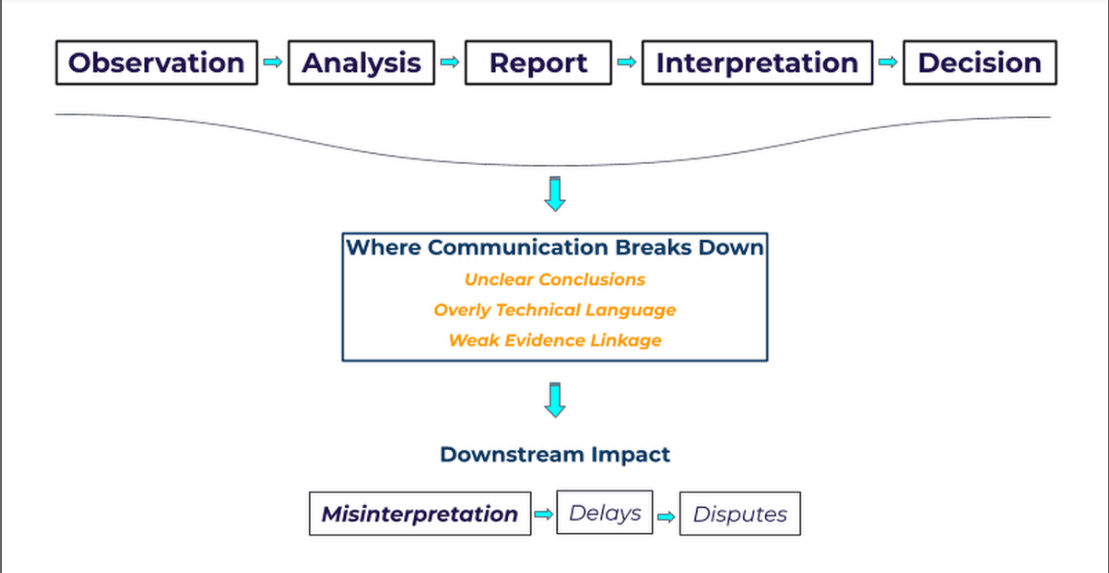
These gaps are often subtle, but they have a direct impact on how findings are understood and applied.
Common Communication Gaps in Engineering Reports
While the breakdown points are often subtle, their impact is significant.
Unclear conclusions can make it difficult for stakeholders to interpret findings confidently, even when the analysis is sound.
Overly technical language can limit accessibility, particularly for adjusters and attorneys who rely on clear, actionable information.
Weak linkage between observations and conclusions can create doubt, especially when findings are reviewed in dispute or litigation settings.
These issues do not reflect a lack of technical rigor—they reflect how that rigor is communicated and applied.
Why Clear Communication Matters in Claims and Litigation
Engineering findings are used to inform decisions, support positions, and resolve disputes.
Poor communication can lead to:
- Delays in claim resolution
- Misinterpretation of damage or causation
- Conflicting expert opinions
- Increased scrutiny in litigation
Clear communication ensures findings are:
- Understood consistently
- Aligned with the scope of the investigation
- Defensible under review or cross-examination
Practical Approach to Communicating Findings
Effective communication is not about simplifying technical work—it is about structuring it appropriately.
Key practices include:
- Present clear conclusions
- Use structured reporting (observations → analysis → conclusions)
- Translate findings without diluting technical accuracy
- Clearly link evidence to conclusions
- Write with the audience in mind
Structuring Reports for Clarity and Efficiency
A key aspect of effective reporting is how information is structured for the reader.
Often, conclusions are presented at the end of a report, requiring stakeholders to interpret technical details before understanding the outcome. This can lead to confusion or misalignment, particularly for non-technical audiences.
A more effective approach is to present the scope of the investigation and the corresponding conclusions early in the report. This allows adjusters, attorneys, and other stakeholders to understand the key findings quickly, while still having access to the detailed analysis that supports those conclusions.
This structure supports both efficiency and defensibility,ensuring that the report can be readily understood at a high level, while also standing up to detailed technical or legal review.
Prema’s Approach
Prema applies a structured, evidence-driven methodology to forensic engineering and building assessments.
Each assignment is approached with:
- Clearly defined scope
- Documented observations
- Structured evaluation
- Defensible conclusions aligned with available evidence
This approach ensures both technical rigor and clear communication, enabling stakeholders to interpret confidently and apply the findings.
Conclusion
Clear communication is central to the effectiveness of forensic engineering.
Well-structured, understandable findings support accurate evaluations, reduce delays, and ensure that conclusions are aligned with the intended scope of the investigation.





Need Expert Forensic Engineering & Building Assessment Insights?
Get our accurate, evidence-based analysis to identify root causes, assess structural integrity, and make confident decisions.
Get in Touch →