A milestone inspection finding of substantial structural deterioration requires an association to move from documenting building conditions to coordinating further evaluation and appropriate follow-up. Boards and community association managers need to understand what the finding means, what the inspection professional recommends and what the local building authority requires.
The next steps may involve Phase 2 investigation, safety-related measures, repair planning and separately commissioned repair design. Those activities serve different purposes and should have clearly defined scopes, responsible parties and schedules.
Prema can support the engineering continuum from documented milestone findings through additional evaluation and, where separately engaged, repair/remediation design and construction-phase support.
What Does Substantial Structural Deterioration Mean?
Section 553.899 defines substantial structural deterioration as significant structural distress or weakness adversely affecting the building’s overall structural condition and integrity. Surface imperfections alone are excluded unless the inspecting engineer or architect determines they indicate this deterioration. [1]
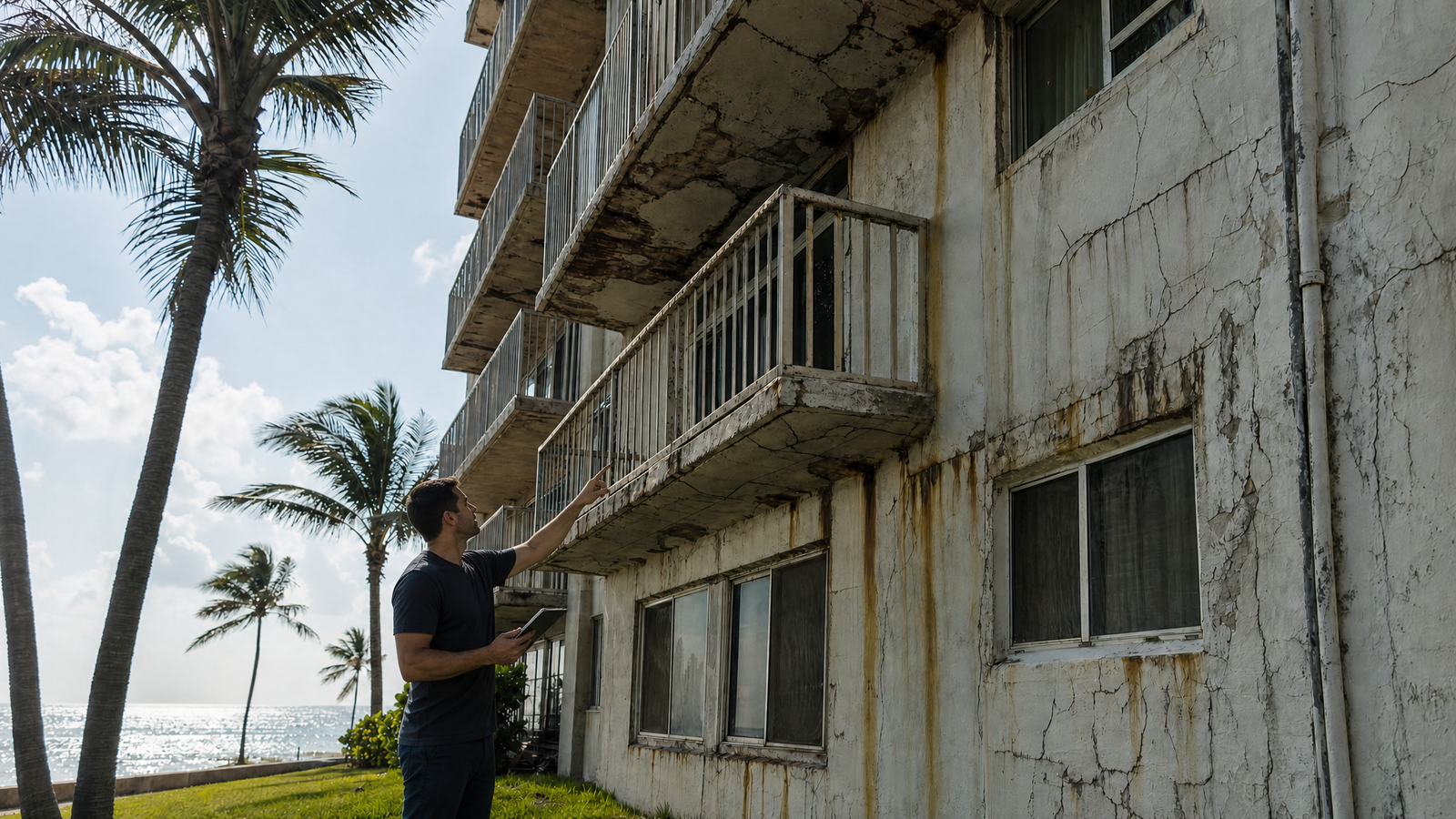
A board should ask the inspection professional to explain the finding in building-specific terms. Which components are affected? What evidence supports the conclusion? What remains unknown? A photograph of cracking or concrete spalling can document a condition, but its significance depends on the affected component, material condition and structural role.
Avoid interpreting a technical term solely from the appearance of an isolated area. The report and the professional’s explanation should guide the association’s response.
Step 1: Review the Findings and Safety Recommendations
DBPR explains that milestone reports identify deterioration, recommended repairs, items needing further inspection and whether unsafe or dangerous conditions were observed. They also include a separate findings summary. [2]
Treat these as distinct questions:
-
What deterioration has been identified?
-
Were unsafe or dangerous conditions observed?
-
What immediate measures, if any, are recommended?
-
What additional information is needed?
-
What permanent repairs may be necessary?
A deterioration finding does not, by itself, establish that the entire building must be vacated. Occupancy decisions and restrictions depend on the specific conditions, professional recommendations and direction from the authority with jurisdiction.
If the engineer recommends restricted access, temporary support or other protective measures, clarify the affected areas, implementation responsibilities and required oversight promptly. Do not treat a future repair schedule as a substitute for addressing an immediate concern.
Step 2: Arrange Phase 2 Where Required
Substantial structural deterioration identified in Phase 1 requires Phase 2. Testing may be destructive or nondestructive. Within 180 days after Phase 1 report submission, the Phase 2 professional must submit a progress report and completion timeline to the local enforcement agency; this is not a universal Phase 2 completion deadline. [1]
DBPR describes Phase 2 as an evaluation that can involve testing and recommendations for assessing and repairing damaged portions of the building. [2]
Before fieldwork, the association should coordinate:
-
Access to units, balconies, roofs and other affected areas
-
Available drawings, prior inspection reports and repair records
-
Identification of concealed components requiring investigation
-
Resident notices and arrangements for disruptive work
-
Responsibilities for opening and restoring test locations
-
A primary association contact for scheduling and questions
Testing should answer defined engineering questions. Depending on the condition, additional work may help establish material properties, reinforcement condition, connection details or the extent of concealed deterioration. The engineer should explain how those results will inform the evaluation.
Step 3: Separate Further Evaluation From Repair Design
An inspection report documents findings and recommendations. Repair design translates the evaluated condition into project-specific construction requirements. An association should confirm which deliverables are included before assuming that an inspection engagement covers design and construction services.
Further evaluation may refine the extent of damage or resolve uncertainty about an affected component. Repair design may address:
-
Repair limits and details
-
Materials and compatibility with the existing structure
-
Structural connections and load transfer
-
Construction sequencing and temporary support
-
Permit documentation appropriate to the work
-
Required testing, observations and acceptance criteria
For example, an investigation may identify deterioration in balcony concrete and reinforcement. Additional evaluation may define how far the condition extends. A separate design engagement can then develop repair details based on those findings.
Where concealed conditions remain uncertain, the design and construction scope should explain how newly exposed conditions will be evaluated and how changes will be documented.
Step 4: Confirm Local Requirements and Repair Timing
Local ordinances establish scheduling requirements, but repairs must commence within 365 days after receipt of the Phase 2 report. Missing required proof of scheduled or commenced repairs triggers an agency review of whether the building is unsafe for occupancy. [1]
Ask the local building department to confirm applicable submission procedures, deadlines and required evidence. Build an action log that records the report date, authority communications, assigned responsibilities and upcoming milestones.
The statutory outer limit should not be used as a target for delaying urgent work. A project schedule should account for the condition, professional recommendations, access, design, permitting and contractor availability.
Step 5: Communicate With Owners and Preserve Records
DBPR states that associations must distribute the inspector-prepared summary within 45 days of receiving the report, post it conspicuously and publish the report and summary on the association website where required. Confirm the statute’s prescribed delivery methods. [2]
Communications should distinguish confirmed findings from unresolved questions. Explain the next engineering step, any access arrangements and how updates will be provided without promising outcomes that have not yet been established.
Maintain a central project record containing:
-
Inspection reports and findings summaries
-
Testing results and supplemental evaluations
-
Building-department correspondence
-
Repair drawings and approved revisions
-
Contractor records and progress documentation
-
Construction observations and completion documentation
Consistent records help subsequent boards, managers and professionals understand what was found, what was recommended and what work was completed.
Step 6: Plan Construction-Phase Support and Follow-Up
Repair implementation requires coordination between the association, design professional, contractor and building authority. Define the engineer’s construction-phase role before work starts.
That role may include reviewing relevant submittals, responding to technical questions, evaluating exposed conditions and observing specified stages of work. The scope should identify observation frequency and required documentation rather than implying continuous oversight.
DBPR guidance describes post-repair professional reinspection and an amended report. Coordinate the required closeout process with the local authority and engineering team. [2]
Completion records should show how the repair work relates to the identified conditions. Confirm whether further monitoring or maintenance recommendations remain after construction.
Questions Associations Should Ask Before Engaging Repair Services
-
Does the proposal cover investigation, design, construction support or a combination?
-
Which conditions and building areas are included?
-
What additional testing may be needed before design?
-
Who will coordinate permitting and local submissions?
-
How will unexpected concealed conditions be handled?
-
What observations and completion documents are included?
-
What disclosures are required if the inspection provider proposes follow-up services?
Section 553.899 requires written disclosures concerning proposed follow-up bids and specified relationships between inspection and repair-service providers. Address these before engagement. [1]
Supporting the Transition From Findings to Repair Planning
A substantial structural deterioration finding calls for a coordinated response grounded in the building’s actual conditions. Clear scopes help associations connect investigation results with design and implementation while keeping each professional’s responsibilities understandable.
Prema supports associations with documented milestone findings, additional structural evaluation and, where separately engaged, repair/remediation design and construction-phase engineering support. The appropriate next step depends on the findings, unresolved technical questions and requirements of the local authority.
Discuss Your Milestone Inspection or Repair Design Needs
Prema helps Florida condominium and cooperative associations connect documented structural findings with appropriate evaluation and repair-planning steps.
Contact Prema to discuss your milestone inspection or repair design needs.
Primary Sources and Publication Review
Requirements reviewed October 8, 2026. Recheck current statutory text, agency guidance and applicable local procedures immediately before publication and during future updates.
-
Florida Legislature — Section 553.899, Mandatory Structural Inspections
-
Florida DBPR — Milestone Inspection Information
Frequently Asked Questions
Does substantial structural deterioration mean the building has collapsed?
−No. The finding concerns structural distress or weakness. Boards should obtain a building-specific explanation of the affected components, structural implications and any safety recommendations.
Is Phase 2 required after this finding in Phase 1?
+Yes. Section 553.899 requires Phase 2 when Phase 1 identifies substantial structural deterioration. The scope should address the conditions identified. [1–2]
Does the milestone report include construction-ready repair drawings?
+Associations should not assume it does. Confirm whether repair design is included or requires a separate engagement, and identify the deliverables needed for permitting and construction.
Can the association wait until the repair deadline to address safety concerns?
+A repair deadline does not replace immediate professional recommendations or building-authority direction. Clarify and act on any urgent measures separately from the permanent repair schedule.
Can Prema support both evaluation and repair design?
+Prema can support additional evaluation and, where separately engaged, repair/remediation design and construction-phase support within the agreed scope, with applicable disclosures addressed.
Our Related Services
Need Expert Forensic Engineering & Building Assessment Insights?
Get our accurate, evidence-based analysis to identify root causes, assess structural integrity, and make confident decisions.
Get in Touch →