
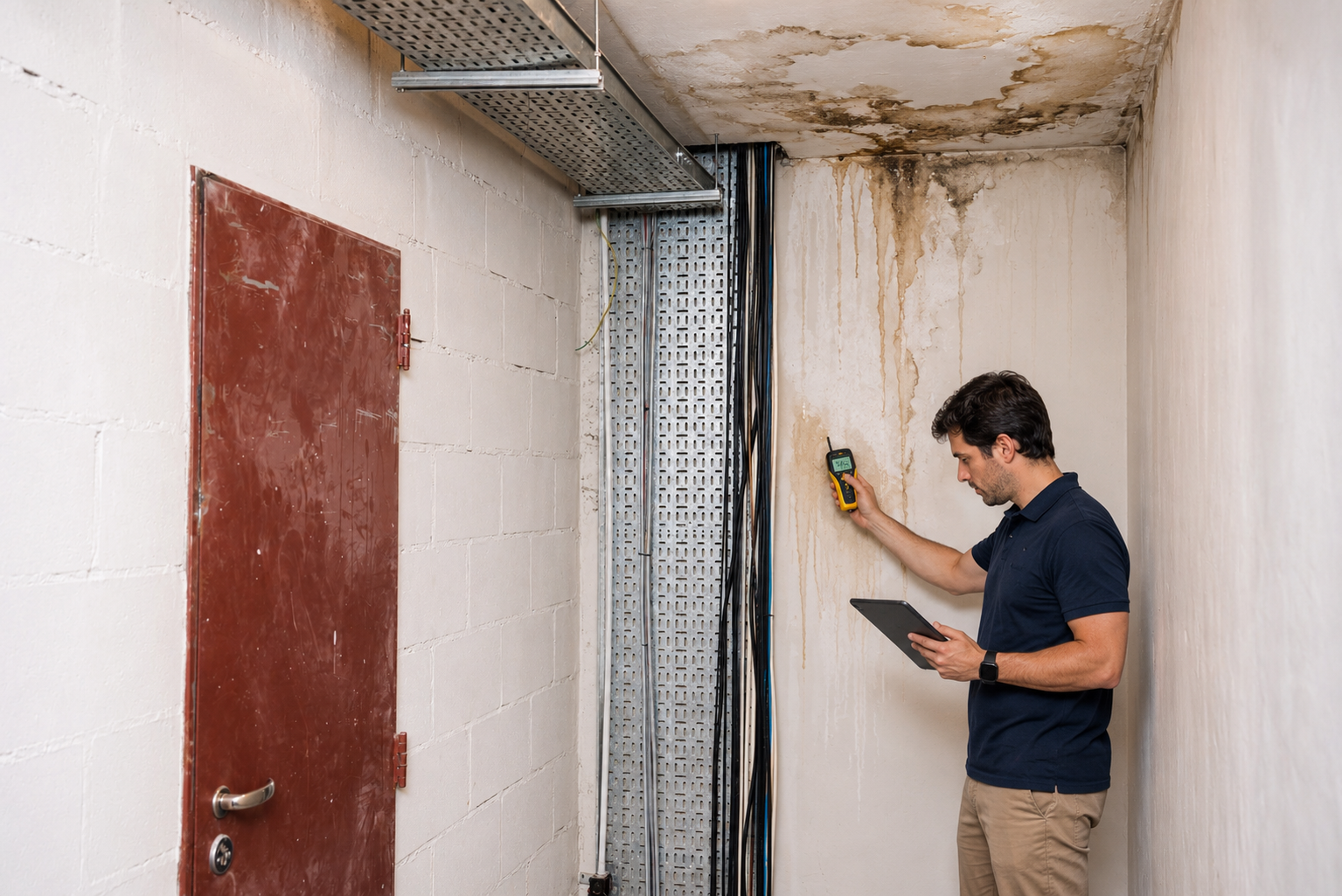
A recurring leak can damage finishes without affecting the structure. In other cases, prolonged wetting contributes to decay, corrosion, or deterioration within structural components that are partly or entirely concealed.
For commercial owners and property teams, the question is whether moisture has reached framing, reinforcement, connections, or other load-bearing elements and caused a physical change that matters to their performance.
There is no single exposure duration or moisture reading that establishes structural damage. Engineers evaluate the materials affected, the deterioration mechanism, its extent, and the role of each component. Confirming reduced structural capacity requires additional evidence and analysis appropriate to the condition.
Moisture Exposure, Structural Damage, and Structural Impairment
These conditions are related, but they require different evidence.
Moisture exposure means water or elevated moisture is present or has affected materials. Staining, damp finishes, and elevated instrument readings can support that finding.
Structural damage involves physical deterioration or damage to a structural component. Examples include decay in load-bearing wood framing, measurable steel section loss, or corrosion-related distress affecting reinforced concrete.
Structural impairment involves an effect on the component or system’s ability to perform, such as reduced strength, stability, or connection capacity. Damage to a structural component does not automatically establish that it is unable to support required loads.
Engineering evaluation connects the observed condition with its structural significance. The visible extent of a leak may not represent the full extent of concealed deterioration.
How Moisture Can Affect Structural Materials
Wood Framing
Sustained moisture conditions can support fungal decay in susceptible wood. Deterioration may affect joists, beams, columns, roof framing, or supporting substrates within enclosed assemblies.
Engineers may evaluate:
- Softening or loss of sound material
- The location and extent of deterioration
- Remaining member dimensions and condition
- Bearing areas and connections
- The relationship between wetting and adjacent components
Wet wood is not automatically decayed, and drying does not restore material already lost to decay. The investigation must distinguish current moisture conditions from existing physical deterioration.
Structural Steel and Metal Connections
Moisture exposure can contribute to corrosion of steel members, fasteners, and attachments. The significance depends on material loss, its distribution, and the structural function of the affected element.
Engineers may assess remaining thickness, localized pitting, connection condition, and the demands on the component. Surface rust alone does not quantify section loss or establish inadequate capacity.
Small connections can be important even when nearby members appear sound. Deterioration at a critical attachment may require attention disproportionate to its visible size.
Reinforced Concrete
Concrete normally protects embedded reinforcement through its alkaline environment. Conditions such as chloride exposure or carbonation can reduce that protection; moisture and oxygen can then support corrosion.
Corrosion products may contribute to cracking, delamination, and spalling. Evaluation may need to consider reinforcement section loss, bond, anchorage, and the remaining concrete section.
Engineers assess the mechanism and extent rather than assuming that every crack or spall results from moisture-related corrosion. Falling concrete can also create a localized hazard even when overall structural capacity has not been established as deficient.
Connections, Bearing Areas, and Interfaces
Water can collect at joints, concealed supports, and transitions between materials. These areas may be difficult to inspect and important to load transfer.
An evaluation considers how deterioration affects fasteners, bearing surfaces, anchors, and adjoining members. A localized condition can matter if it occurs at a critical connection or support.
What Conditions Warrant Structural Evaluation?
Structural review may be appropriate when moisture-related findings involve:
- Deterioration of load-bearing framing
- Corrosion or material loss at structural connections
- Exposed reinforcement or corrosion-related concrete distress
- Persistent wetting at concealed supports or bearing areas
- Deformation, displacement, or cracking associated with affected members
- Uncertain concealed deterioration before major repair work
These observations guide the scope of evaluation. They do not independently establish structural failure.
Active movement, loose overhead materials, or pronounced deterioration at supports may require prompt site-specific assessment. Access restrictions or temporary support should be determined by qualified professionals based on the conditions.
Why Duration Alone Does Not Determine Structural Damage
Repeated wetting may create conditions for deterioration, but its effect varies with material, temperature, exposure, protective systems, and the ability of an assembly to dry.
A short-duration leak can damage finishes, while a recurring concealed leak may affect framing over time. An older stain can remain visible after the moisture source has been corrected.
Engineers therefore evaluate:
- Evidence of repeated or sustained exposure
- Material condition and deterioration mechanisms
- Protective coatings, barriers, and drainage
- Concealed locations where moisture may accumulate
- Available records of leaks, repairs, and changes
The exact onset or duration of deterioration may remain uncertain. Reports should distinguish documented history from estimates and assumptions.
How Engineers Connect Moisture Findings With Structural Assessment
Step 1: Establish Source and Distribution
The moisture investigation evaluates where water enters or accumulates and which areas are affected. Visual observations, moisture mapping, records, and targeted testing may help trace the pathway.
Measurements require interpretation. A high moisture reading can guide further work but does not measure structural capacity.
Step 2: Identify Structural Components Along the Pathway
Engineers compare the moisture findings with the building’s framing and support system. They identify members, reinforcement, connections, and bearing areas that may have been exposed.
Drawings and accessible conditions can help establish the structural arrangement. Additional access may be needed when the affected components are concealed.
Step 3: Evaluate Physical Deterioration
The assessment documents material condition and the extent of damage. Methods may include measurements, selective openings, probing where appropriate, or specialist testing.
The selected method should answer a specific question, such as the remaining steel thickness or the extent of sound wood. Results apply to the inspected locations, and sampling limits should be identified.
Step 4: Assess Structural Significance
Where warranted, engineers evaluate the remaining component against relevant loads and performance requirements. The review may consider:
- Remaining section and material properties
- Member geometry and support conditions
- Connection capacity and continuity
- Interaction with adjacent elements
- Strength, stability, and serviceability
This analysis helps distinguish deterioration requiring repair from conditions that also affect structural capacity or stability.
Step 5: Define Appropriate Next Steps
Recommendations may include further access, structural analysis, repair design, interim measures, or coordination with other specialists.
The moisture source and damaged components both require consideration. Correcting leakage does not restore lost material, while repairing a structural element without addressing recurring wetting can leave the deterioration mechanism active.
Florida Examples That May Inform the Evaluation
Florida properties may involve prolonged wetting, high humidity, and coastal exposure. Chloride exposure can be relevant to reinforcement corrosion, and recurring envelope leakage may affect concealed framing or connections.
For example, moisture-related staining near a coastal concrete balcony may prompt investigation of reinforcement condition and related distress. The stain alone does not establish corrosion extent or structural impairment.
Similarly, recurring leakage at a roof-to-wall transition may warrant inspection of concealed supports. The evaluation should establish the actual component condition rather than infer structural damage from exposure or location.
What Property Teams Should Expect From the Findings
A useful report explains what is observed, what is supported by analysis, and what remains unresolved.
Depending on the scope, findings may include:
- Moisture sources and affected areas evaluated
- Structural components inspected
- Type and extent of documented deterioration
- Measurements, testing, and analysis performed
- Structural implications supported by the evidence
- Concealed areas and access limitations
- Recommended further evaluation or corrective planning
A report may identify deterioration without having enough evidence to quantify capacity. That distinction should be clear before the findings are used to plan work or make operational decisions.
Detailed repair design, construction support, and verification should be defined when needed. Suspected microbial conditions may require a separately qualified assessment.
Preparing for an Evaluation
Property teams can provide dated photographs, leak logs, drawings, maintenance records, prior repair scopes, and previous reports. Identify affected locations, inaccessible areas, and sensitive operations before the visit.
Where practical, document conditions before materials are removed. Necessary measures to limit ongoing damage should proceed, with records retained to explain site changes.
Coordinate access to ceilings, wall cavities, roof areas, and structural components as needed. For occupied facilities, planning should address tenant impacts, equipment protection, and restoration of investigative openings.
Speak with a Prema Engineer
Prema Consulting Group can connect moisture-intrusion findings with structural evaluation where deterioration may affect framing, reinforcement, connections, or other structural components.
Our team supports commercial owners, property and facility managers, and asset managers with documented observations and engineering analysis to understand affected conditions and plan appropriate next steps.
Contact Prema to speak with an engineer about moisture-related structural concerns at your property
Frequently Asked Questions
Does every leak cause structural damage?
−No. A leak may affect finishes or other nonstructural materials. Structural evaluation becomes relevant when exposure or deterioration involves load-bearing components, reinforcement, connections, or supports.
Does corrosion mean a structural member is unsafe?
+Not automatically. Engineers evaluate material loss, location, structural function, and applicable loads to determine significance. Surface appearance alone does not establish remaining capacity.
Can drying restore a damaged structural component?
+Drying may help stop ongoing moisture exposure, but it does not replace material lost through decay or corrosion. Existing deterioration may require separate repair evaluation.
Can moisture damage be concealed?
+Yes. Deterioration may occur within enclosed assemblies or at hidden connections. Additional access or testing may be needed to determine extent.
When should a moisture investigation include structural engineering?
+Structural input may be appropriate when findings indicate deterioration of framing, reinforcement, connections, or supports, or when concealed conditions leave questions about structural performance.
Our Related Services
Need Expert Forensic Engineering & Building Assessment Insights?
Get our accurate, evidence-based analysis to identify root causes, assess structural integrity, and make confident decisions.
Get in Touch →