
A commercial roof can have recurring leaks, deteriorated details, or drainage concerns without an obvious need to replace the entire system. Owners and property teams need a documented understanding of its condition before deciding what work to prioritize.
A roofing survey and evaluation reviews the roof system, accessible components, reported history, and related moisture conditions. The findings can support maintenance, repair planning, and decisions about further testing or design.
The assessment scope matters. A visual survey documents accessible conditions; concealed materials, attachment performance, or moisture within an assembly may require separately defined investigation methods.
What Is a Commercial Roofing Survey and Evaluation?
A commercial roofing survey records existing roof conditions and evaluates their significance in relation to the assignment objectives.
The work may address:
- Recurring leakage or reported performance concerns
- Maintenance needs and repair priorities
- Conditions following a reported event
- Existing conditions before planned improvements
- Questions about whether further testing or repair design is needed
The scope should identify the roof areas, components, records, and methods included. A condition survey does not automatically include structural analysis, a replacement design, a cost estimate, or confirmation of concealed assembly conditions.
What the Assessment Commonly Includes
Roof System Type and Configuration
Engineers identify the accessible roof-system characteristics and review available construction information.
Commercial systems may include single-ply membranes, modified bitumen, built-up roofing, metal roofing, or other coverings. Their details and performance considerations differ.
The assessment may document:
- Roof areas and changes in elevation
- Covering type and accessible assembly information
- Slopes and drainage configuration
- Equipment locations and penetrations
- Interfaces with walls, parapets, and adjoining roofs
Records may help identify insulation, attachment, or deck characteristics that cannot be confirmed visually. Reports should distinguish documented information from field-verified conditions.
Membranes and Roof Coverings
Engineers evaluate accessible covering conditions and the distribution of distress.
Observations may include:
- Tears, punctures, or surface deterioration
- Open seams or joints
- Blisters, wrinkles, or displacement
- Coating condition where applicable
- Localized damage and repeated repair areas
The significance depends on the roof material, location, extent, and relationship to reported performance. Surface appearance alone does not establish remaining service life or the condition of underlying materials.
Flashings and Terminations
Flashing protects vulnerable intersections and helps integrate the roof with adjoining components.
The evaluation may consider:
- Roof-to-wall and parapet details
- Perimeter and edge conditions
- Terminations and counterflashing
- Equipment curbs and transitions
- Connections between different roofing materials
Engineers assess the accessible detail and whether it provides evidence of a potential water-entry pathway. Concealed integration may require additional access or testing.
Drainage Features
Drainage review considers how water leaves the roof and whether observed conditions interfere with that function.
Relevant areas include:
- Drains, scuppers, gutters, and downspouts
- Debris or visible obstructions
- Slope and drainage pathways
- Evidence of ponding or repeated water accumulation
- Overflow drainage features within the scope
A dry visit may not show how the roof performs during rain. Historical photographs and maintenance records can help document intermittent accumulation.
A visual review does not automatically include hydraulic calculations or confirmation that drainage capacity satisfies applicable requirements. Those questions require an appropriate analysis scope.
Penetrations and Rooftop Equipment Interfaces
Vents, piping, conduits, and equipment supports create details that must be integrated with the roofing system.
The assessment may review flashing, seals, curbs, nearby repairs, and evidence of distress. Engineers may also consider whether equipment drainage or maintenance activity could contribute to reported conditions.
Evaluating the roof interface does not automatically include mechanical equipment performance or plumbing diagnostics. Additional expertise may be needed when those systems are involved.
Visible Substrate and Deck Indicators
The roof deck and supporting materials may be concealed. Engineers review accessible indicators that suggest further evaluation is warranted.
Examples include:
- Localized deformation or unusual surface profile
- Visible deterioration at accessible edges or openings
- Corrosion or distress observed from below
- Staining near supports or deck areas
- Conditions encountered at existing access locations
These observations can guide further work but do not establish the condition of the entire deck. Structural concerns, concealed deterioration, or attachment questions may require additional access, testing, or structural assessment.
Prior Repairs and Alterations
Previous work can explain how roof conditions have changed and where symptoms recur.
Engineers may review patches, overlays, replacement details, new penetrations, equipment changes, and available repair records. The evaluation considers compatibility and integration with the existing system.
A patched area is evidence of prior work, not proof of an active leak. Recurring repairs at the same location may warrant closer investigation of the underlying detail or an adjacent source.
Moisture-Related Conditions
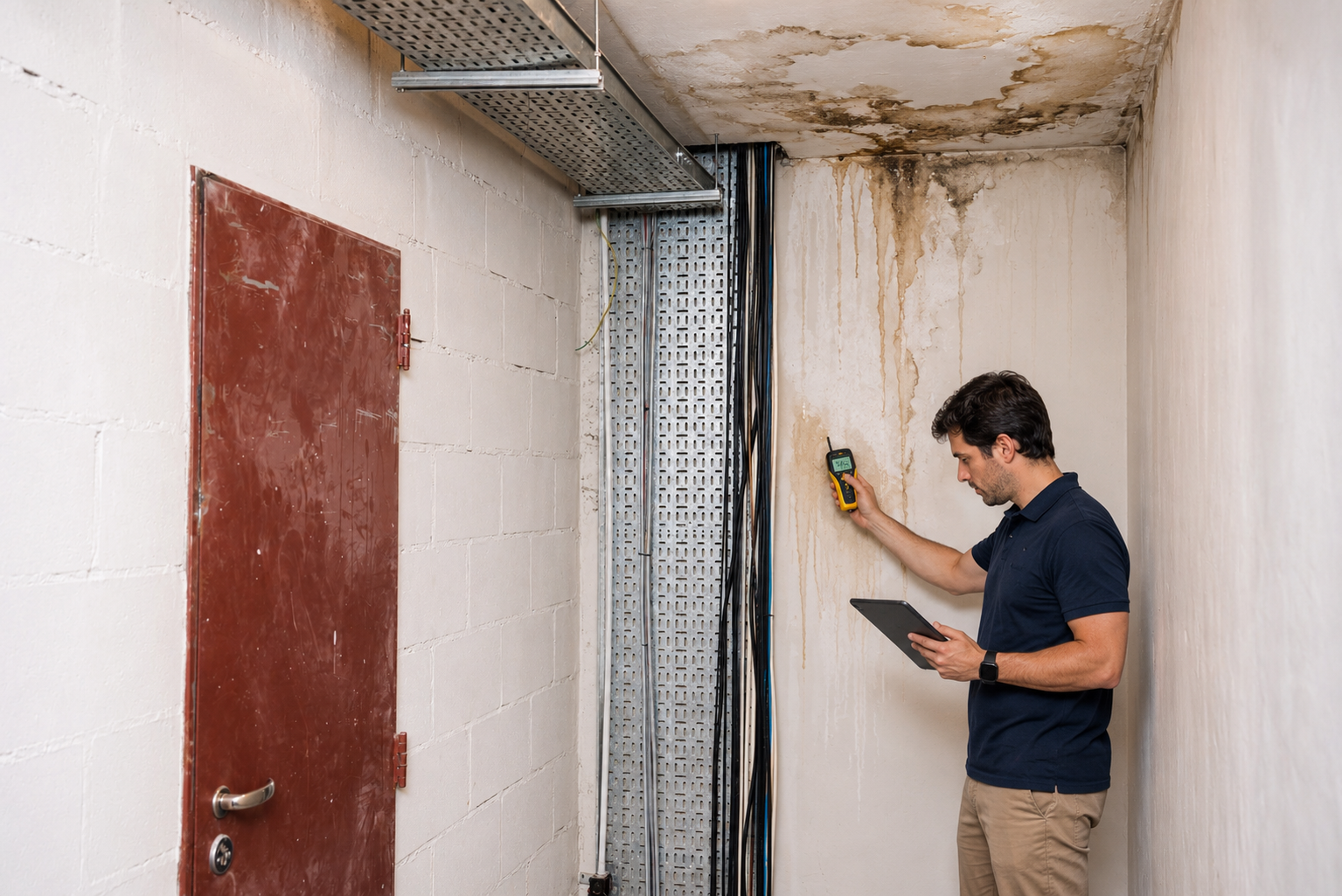
Roof evaluations may include accessible interior evidence and moisture-related observations relevant to the reported problem.
The assessment may consider:
- Ceiling stains and reported leakage locations
- Deterioration near roof interfaces
- Available moisture surveys or prior test results
- Whether concealed wetting is suspected
- Alternative sources such as walls, plumbing, or condensation
Interior damage does not establish a roof source by itself. Water may travel within an assembly before appearing, and more than one mechanism may be involved.
How the Evaluation Is Performed
Review Available Information
Useful records include roof plans, installation information, maintenance logs, leak histories, prior reports, warranties, and repair documentation. Weather information may be reviewed when relevant to the assignment.
Records help guide the investigation but do not replace field verification of accessible conditions.
Document Accessible Conditions
Engineers map relevant observations, photograph details, and record measurements where appropriate. Interior symptoms may be compared with roof locations and adjacent envelope systems.
Access, safety conditions, equipment congestion, and weather can limit the areas inspected. Those limitations should be identified in the report.
Evaluate Findings and Further Investigation Needs
The analysis considers the roof system, observed condition, reported history, and available evidence. It identifies supported findings and questions that require additional methods.
The scope should reflect the decisions the property team needs to make rather than treating every survey as a complete diagnosis of all roof performance concerns.
When Is Additional Roof Testing Appropriate?
Testing may be useful when concealed moisture, assembly composition, attachment, or a leakage pathway remains uncertain.
Depending on the question, further work may include:
- Targeted moisture measurements or a moisture survey
- Infrared imaging under suitable conditions
- Limited roof openings or cores
- Controlled water testing of selected details
- Testing of attachment or materials
- Structural evaluation of deck or supporting components
Infrared imaging identifies temperature patterns rather than directly measuring moisture. Suspected wet areas require corroboration, and testing methods must suit the roof assembly and conditions.
Openings and sampling should be coordinated with the property team, including protection of occupied spaces and restoration of disturbed roofing. Findings apply to the locations and conditions evaluated.
Florida Considerations for Commercial Roofs
Florida wind, rainfall, humidity, and coastal exposure may inform the questions addressed in a roof evaluation.
For example, heavy rainfall can highlight drainage concerns, while wind-driven rain may involve roof-to-wall interfaces or adjacent envelope details. Coastal exposure may be relevant to corrosion of metal components. Reported wind effects require evaluation of actual damage patterns and available evidence.
Code questions should be tied to the roof system, jurisdiction, and proposed work. A survey does not automatically determine every requirement for a future repair or reroofing project; that review may require a separate design or permitting scope.
Exposure alone does not establish a damage cause or require replacement of a particular roof.
What Property Teams Should Expect From the Report
A useful report connects documented observations with practical next steps.
Depending on the assignment, it may include:
- Roof-system description and areas inspected
- Photographs and mapped condition locations
- Covering, flashing, drainage, and penetration findings
- Prior repair and moisture-related observations
- Evaluation of technical significance
- Access limits and unresolved questions
- Recommended maintenance, repair planning, or further testing
Recommendations should distinguish work supported by the assessment from decisions requiring additional investigation. Remaining service life, budgets, repair design, and replacement specifications should be included only when appropriately scoped and supported.
Using Findings for Maintenance and Repair Decisions
A roof evaluation can help property teams organize work by condition, recurrence, and consequence.
Next steps may range from clearing drainage features or repairing a localized detail to further investigation of concealed materials or repeated system conditions. Widespread replacement decisions require a supported understanding of the assembly and available options.
Corrective planning should consider tenant impacts, equipment access, sensitive operations, and construction sequencing. Detailed design, construction support, and verification after repairs should be defined when needed.
Preparing for a Commercial Roofing Evaluation
Provide available drawings, leak logs, dated photographs, maintenance records, and prior repair scopes. Identify roof access arrangements, restricted areas, equipment constraints, and interior locations associated with reported leakage.
Photographs taken during active leaks or water accumulation can be useful when the site visit occurs in dry conditions. Necessary measures to limit ongoing damage should proceed, with records retained to explain changes before the inspection.
Discuss a Commercial Roofing Evaluation
Prema Consulting Group evaluates roof-system type, membranes and coverings, flashings, drainage, penetrations, visible substrate and deck indicators, prior repairs, and moisture-related conditions to support maintenance and repair decisions.
Our team helps commercial owners, property and facility managers, and asset managers understand documented roof conditions and determine appropriate next steps for further investigation or corrective planning.
Contact Prema to discuss a commercial roofing evaluation for your property
Frequently Asked Questions
What does a roofing survey and evaluation include?
−It commonly includes review of roof-system type, coverings, flashings, drainage, penetrations, accessible deck indicators, prior repairs, and relevant moisture conditions. The exact scope depends on the assignment.
Does every roofing survey include moisture testing?
+No. Testing is selected according to the questions and available evidence. A visual survey may identify a need for additional moisture investigation.
Can a visual survey confirm the condition of the roof deck?
+Only accessible areas and visible indicators can be assessed directly. Concealed deck conditions may require openings, testing, or structural evaluation.
Does roof deterioration always mean replacement is required?
+No. The appropriate approach depends on the extent, system condition, performance concerns, repair feasibility, and applicable project requirements.
Is a roof evaluation the same as a reroofing design?
+No. An evaluation documents and analyzes existing conditions. Reroofing design develops project-specific construction details and requirements under a separately defined scope.
Need Expert Forensic Engineering & Building Assessment Insights?
Get our accurate, evidence-based analysis to identify root causes, assess structural integrity, and make confident decisions.
Get in Touch →