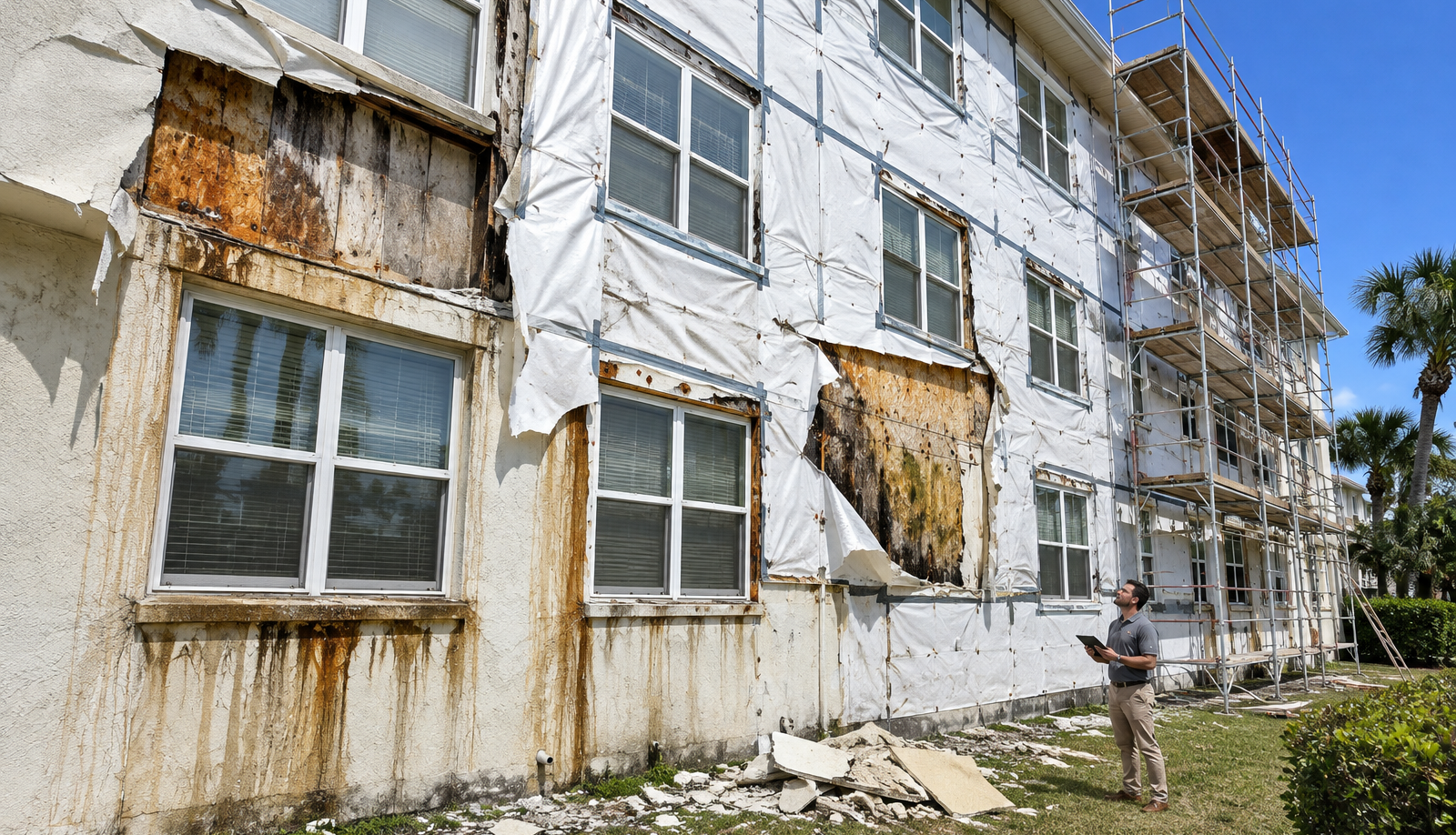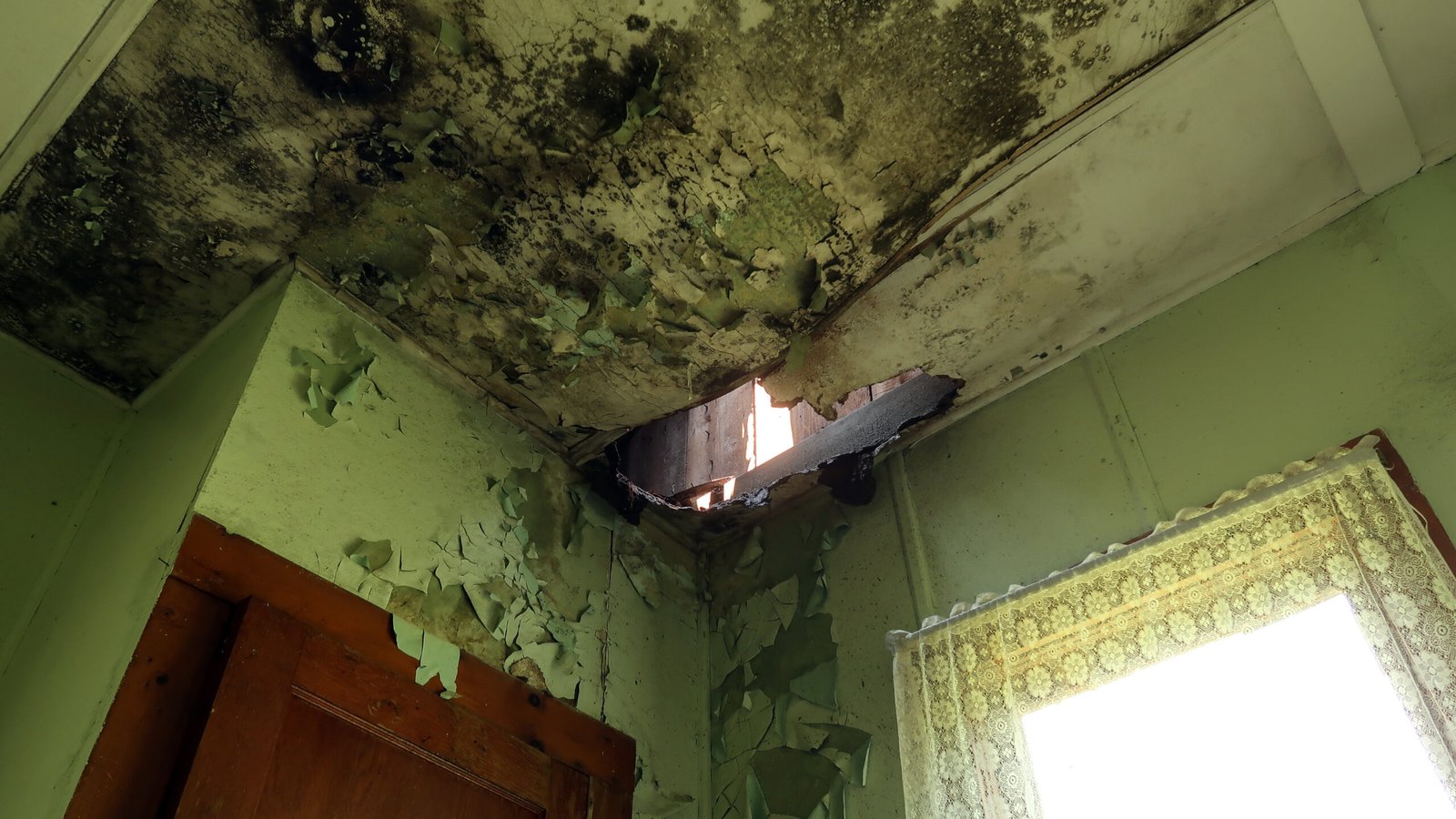

Moisture problems in commercial buildings often become apparent through small changes: a stain that returns, paint that begins to blister, or deterioration near an exterior opening. The affected materials behind a wall, above a ceiling, or beneath a roof covering may remain concealed.
For owners, property and facility managers, and asset managers, recognizing signs of moisture intrusion can help identify conditions that warrant investigation before repeated repairs consume additional time and resources.
The eight indicators below can guide observations and documentation. Each requires context: similar symptoms can result from different mechanisms, and a visible sign alone does not establish the source, extent, or structural significance of a moisture problem.
What Makes Moisture Intrusion Hidden?
Moisture may enter at one location, travel through an assembly, and become visible elsewhere. It can also remain within enclosed materials without producing an obvious active leak.
Potential concealed areas include:
- Wall cavities and insulation
- Roof assemblies and spaces above ceilings
- Window and door interfaces
- Floor assemblies and covered substrates
- Areas around piping, equipment, and building penetrations
Rainwater leakage is one possible mechanism. Plumbing leaks, condensate drainage problems, and condensation can also produce moisture-related conditions. Understanding the mechanism is essential to selecting appropriate next steps.
8 Signs of Hidden Moisture Intrusion in Commercial Buildings
1. Recurring Stains on Ceilings or Walls
A stain that reappears after painting or replacing finishes may indicate that the moisture source remains unresolved. Expanding discoloration or repeated staining in the same location can help identify a pattern worth investigating.
Property teams should record:
- Where the stain appears and how it changes
- Whether it follows rainfall or equipment operation
- Whether adjacent rooms or floors show similar conditions
- What repairs were performed before the stain returned
A dry stain may reflect earlier wetting. Its location does not necessarily identify the entry point, and its appearance alone cannot establish when the moisture exposure occurred.
2. Blistering Paint or Separating Wall Coverings
Bubbling paint, peeling coatings, or separating wall coverings may be associated with moisture affecting the finish or substrate. Concealed wetting may extend beyond the visibly damaged area.
Engineers consider the condition of the finish, the underlying material, and nearby building details. Adhesion problems, surface preparation, and material compatibility may also contribute to similar symptoms.
Repeatedly refinishing the surface can obscure useful evidence while leaving an underlying moisture pathway unaddressed.
3. Swelling, Warping, or Softening of Materials
Changes in material shape or condition can indicate exposure that is not obvious at the surface. Examples include swollen trim, distorted panels, softened gypsum board, or localized changes in flooring.
Evaluation may consider:
- The materials involved and their response to moisture
- The distribution of affected areas
- Nearby plumbing, exterior openings, and floor transitions
- Whether concealed substrates require inspection
These observations do not automatically indicate structural damage. The role of the affected component and the extent of deterioration determine whether additional structural evaluation is needed.
4. Persistent Musty Odors Without an Obvious Source
A persistent musty odor can prompt investigation of concealed damp materials or possible microbial growth, especially where earlier water exposure is documented.
Record where and when the odor is noticed, whether it changes with HVAC operation, and whether it is concentrated near particular rooms or assemblies. Odor alone does not establish the presence, type, or extent of mold, or a particular health condition.
Suspected microbial conditions may require a separately qualified assessment. Opening potentially affected assemblies should be planned with appropriate professionals rather than treated as routine exploratory maintenance.
5. Repeated Condensation or Unexplained Damp Surfaces
Moisture on windows, piping, ducts, or other cooled surfaces may indicate condensation. Dampness that occurs without rainfall can be especially useful in identifying a mechanism other than exterior rainwater leakage.
Engineers may consider:
- Indoor temperature and relative humidity
- Surface temperatures
- Insulation and air movement
- HVAC operating conditions
- Whether condensation can affect adjacent concealed materials
High humidity alone does not prove that the envelope is leaking. The investigation must distinguish water entering an assembly from moisture forming within it.
6. Rust Staining or Corrosion Near Building Interfaces
Rust staining, corroded fasteners, or deterioration around metal details may indicate repeated moisture exposure. Locations near windows, roof edges, penetrations, or exterior connections can warrant closer review.
The investigation considers whether corrosion relates to water leakage, condensation, coastal exposure, or another condition. It also evaluates the function and condition of the affected component.
Surface staining does not quantify material loss. Where load-bearing members or critical connections are involved, additional measurement and structural assessment may be appropriate.
7. White Deposits on Masonry or Concrete
White deposits known as efflorescence can develop when moisture transports soluble salts to a surface and leaves deposits as it evaporates. Their distribution may help identify areas of moisture movement through porous materials.
Engineers evaluate the substrate, surrounding details, and possible water sources. Not every white deposit is efflorescence, and deposits may remain after the original moisture condition has changed.
Efflorescence alone does not establish an active leak or a construction defect. Recurring deposits, especially with dampness or deterioration, can provide useful evidence for further investigation.
8. Localized Distress Near Windows, Doors, or Exterior Transitions
Repeated deterioration beside windows, below exterior openings, or along wall-to-roof transitions may indicate moisture entering through an adjacent or upstream detail.
Relevant observations include:
- Staining or damaged finishes near the interface
- Open or deteriorated sealant joints
- Flashing or drainage concerns
- Similar distress at other locations with the same detail
An exterior deficiency identifies a possible pathway, not proof that concealed materials are wet. Conversely, apparently intact exterior surfaces do not rule out concealed flashing or integration problems. The complete assembly may require evaluation.
When Do These Indicators Warrant Engineering Evaluation?
An isolated symptom may be addressed through maintenance when its cause and affected area are clear. A technical investigation becomes more useful when conditions recur, extend across multiple areas, or remain unexplained after repairs.
Consider an engineering evaluation when:
- Several indicators occur in the same area
- Damage returns after attempted repairs
- Symptoms appear in multiple rooms, floors, or elevations
- Moisture is suspected within enclosed assemblies
- Deterioration may involve structural components or connections
- A major repair is being planned without a confirmed source
For example, recurring stains beneath several similarly detailed windows may warrant evaluation of those interfaces and the surrounding wall system. The investigation should establish what the evidence supports before a repair approach is applied throughout the building.
How Engineers Evaluate Visible and Concealed Indicators
A moisture intrusion evaluation develops from the reported history and the specific technical questions. The methods are selected to address those questions.
Visual Assessment and Records Review
Engineers review accessible conditions and available leak logs, photographs, drawings, maintenance records, and prior repairs. Interior symptoms are compared with exterior details and nearby plumbing or mechanical systems.
Moisture Mapping
Instrument readings at selected locations can help identify patterns and guide further evaluation. Readings are interpreted according to the instrument, material, and site conditions; they do not establish source or duration by themselves.
Infrared imaging may identify surface temperature differences for follow-up. It does not directly show moisture, so suspected areas require corroboration.
Targeted Testing and Limited Openings
Where appropriate, engineers may recommend controlled water testing, additional measurements, environmental monitoring, or limited openings to inspect concealed details and materials.
Each method has limits. Findings apply to the locations and conditions evaluated, and a dry inspection or unsuccessful attempt to reproduce a leak does not rule out intermittent wetting.
Broader Envelope Investigation
A broader investigation may be warranted when repeated symptoms point to shared details, interconnected systems, or conditions beyond a single affected area. The scope may expand to roofing, exterior walls, waterproofing, openings, and transitions.
Further plumbing, mechanical, materials, or structural expertise may be needed when those systems contribute to the findings.
Florida Conditions That Can Inform the Evaluation
Florida examples can help explain how exposure interacts with building details and operations.
Relevant conditions may include:
- Wind-driven rain reaching openings and transitions
- High outdoor humidity interacting with cooled interior surfaces
- Deteriorated sealants at exposed joints
- Coastal exposure affecting metal components
- Recurring leakage during seasonal rainfall
These factors are considered alongside construction details, maintenance, repair history, and operating conditions. They do not establish a cause on their own, and every investigation is not associated with a storm.
What Property Teams Should Document
A consistent record helps engineers understand intermittent conditions that may not be active during the site visit.
Useful documentation includes:
- Dated photographs with identifiable locations
- A log of leaks, odors, dampness, and finish changes
- Rainfall or operating conditions when symptoms occur
- Prior repairs and whether they changed the problem
- Available drawings and previous inspection reports
- Areas that are inaccessible or require special access
Where practical, photograph conditions before materials are removed or finishes replaced. Necessary measures to limit ongoing damage should proceed, with records retained to show how conditions changed.
Investigation findings can then inform targeted maintenance, further testing, repair planning, or a separately defined design assignment.
Discuss a Moisture Intrusion Evaluation
Prema Consulting Group helps commercial property teams evaluate visible and concealed indicators of moisture intrusion and determine when targeted testing or a broader envelope investigation is warranted.
Through documented observations, review of building conditions, and technical analysis, our team supports commercial owners, property and facility managers, and asset managers in understanding reported moisture concerns and planning appropriate next steps.
Contact Prema to discuss a moisture intrusion evaluation for your commercial property
Frequently Asked Questions
What are signs of moisture intrusion in a commercial building?
−Indicators include recurring stains, blistering finishes, material swelling, musty odors, condensation, corrosion, efflorescence, and distress near exterior interfaces. Each must be evaluated in context.
Can hidden moisture be present without an active leak?
+Yes. Moisture may remain within an assembly after earlier wetting, or leakage may occur only under particular weather or operating conditions. Accessible surfaces may be dry during an inspection.
Does a musty odor prove there is mold behind a wall?
+No. An odor can warrant investigation, but it does not establish mold type, location, or extent. A qualified assessment may be needed to evaluate suspected microbial conditions.
Is every damaged sealant joint a source of water intrusion?
+No. A joint condition may identify a potential pathway, but its relationship to reported leakage requires evaluation of the surrounding assembly and available evidence.
When is a broader building envelope investigation appropriate?
+It may be appropriate when symptoms recur, appear at multiple locations, involve shared construction details, or remain unresolved after localized repairs.
Need Expert Forensic Engineering & Building Assessment Insights?
Get our accurate, evidence-based analysis to identify root causes, assess structural integrity, and make confident decisions.
Get in Touch →