

How Corrosion Contributes to Structural Damage in Property Claims
Corrosion can affect structural steel, embedded reinforcement, and metal connections. Its significance depends on the material loss, location, distribution, and function of the affected component.
Visible rust, staining, or concrete spalling may prompt investigation, but appearance alone does not establish the extent of deterioration or its effect on structural capacity.
For claims professionals, a forensic engineering evaluation can clarify the observed condition, potential mechanisms, structural and durability implications, and any limitations on determining cause or timeframe.
Understanding Corrosion in Building Structures
Corrosion is deterioration of metal through chemical or electrochemical reactions with its environment.
In buildings, affected components may include:
- Structural steel members
- Reinforcing steel embedded in concrete
- Bolts, weld regions, fasteners, and anchors
- Exterior structural elements
- Metal supports and attachments
The evaluation considers the actual material, exposure, and component condition. Corrosion affecting a structural element is deterioration, but it does not automatically establish inadequate capacity or structural failure.
How Corrosion Affects Steel Structural Components
Corrosion may produce general thinning, localized pitting, or section loss. At connections, deterioration may affect fasteners, plates, anchors, or the surrounding material needed to transfer forces.
Engineers may assess:
- Location and distribution of corrosion
- Remaining thickness and localized pitting
- Section loss in members and connection components
- The affected element’s structural role and loading
- Associated deformation or changes in load transfer
The appearance of surface rust does not quantify remaining capacity. Where necessary, targeted measurements and analysis help determine whether material loss affects the required structural function.
How Corrosion Affects Reinforced Concrete Structures
Concrete normally provides an alkaline environment that helps protect embedded reinforcing steel. Chloride exposure or carbonation can compromise that protection, allowing corrosion to develop under suitable conditions.
Carbonation involves reactions with carbon dioxide that reduce concrete alkalinity. Chlorides may enter from marine exposure or other sources.
Potential consequences of reinforcement corrosion include:
- Expansion of corrosion products around the steel
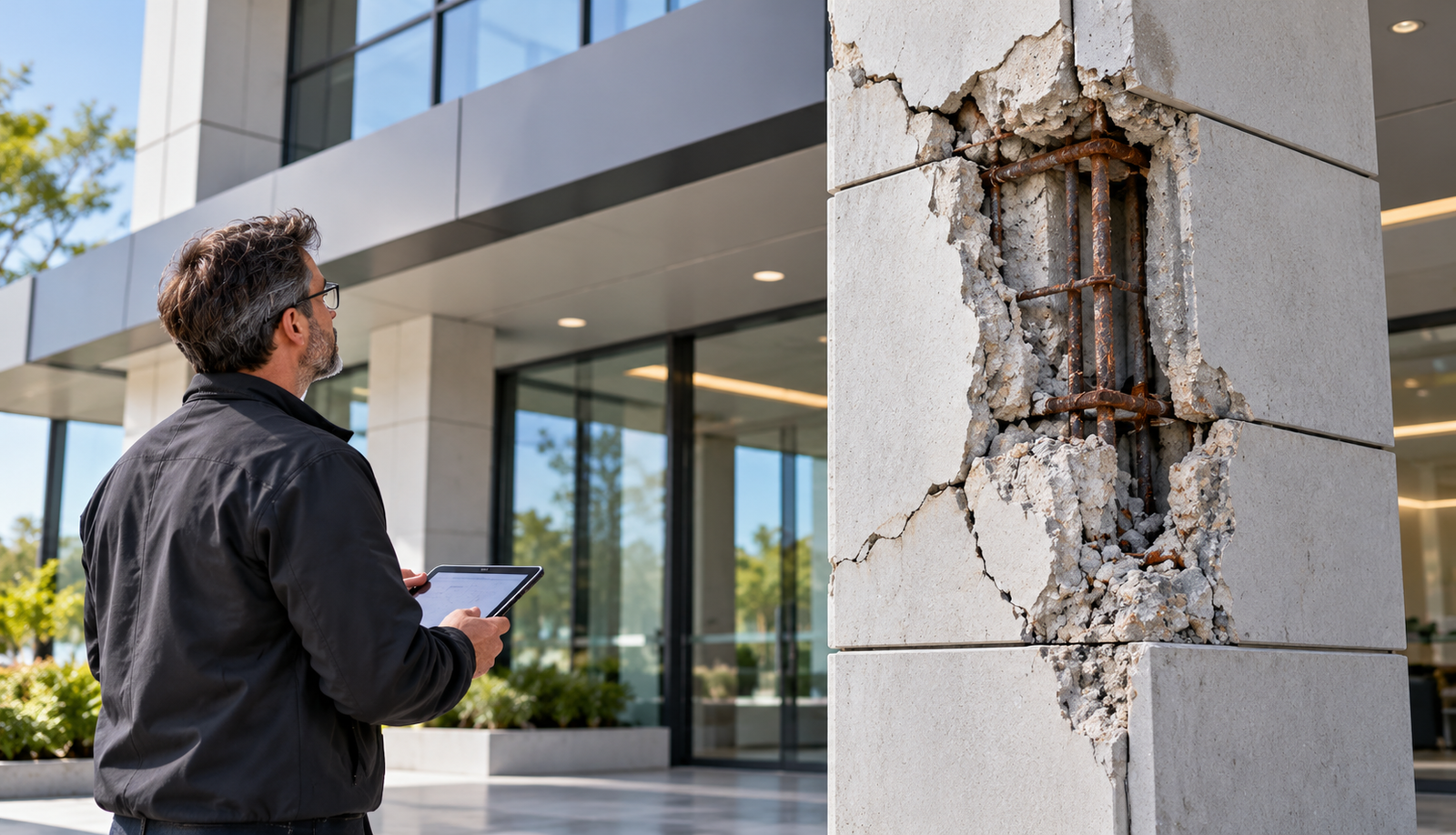
- Concrete cracking, delamination, or spalling
- Loss of reinforcement cross-sectional area
- Deterioration of bond between reinforcement and concrete
- Effects on anchorage and structural performance
Engineers consider both the concrete and reinforcement conditions. Visible deterioration may suggest a mechanism, but its extent and structural significance require evaluation.
Moisture, Coastal Exposure, and Other Environmental Conditions
Exposure conditions relevant to corrosion may include:
- Moisture and oxygen availability
- Chloride exposure
- Wetting and drying cycles
- Damaged coatings or protection systems
- Water trapped at connections or concealed interfaces
- Concrete carbonation and other material-specific conditions
Florida coastal properties provide examples where salt exposure and moisture may be relevant to exposed steel and reinforced concrete.
However, coastal location or high humidity alone does not establish the corrosion mechanism, rate, or severity. Engineers evaluate property-specific exposure, protective systems, material condition, and available history.
Corrosion also occurs in inland buildings, including areas affected by leaks, condensation, or other exposure conditions.
When Engineering Evaluation May Be Appropriate
Evaluation may be appropriate when observations or records identify:
- Apparent section loss, pronounced pitting, or perforation
- Deterioration at connections, anchors, or supports
- Exposed reinforcement associated with cracking or spalling
- Corrosion accompanied by deformation or displacement
- Similar deterioration across multiple components
- Uncertainty about concealed deterioration, capacity, or repair needs
- Questions about the relationship to a reported event
The need and scope depend on the affected element and associated conditions. Surface appearance alone should not be used as a universal severity threshold.
How Engineers Evaluate Corrosion-Related Structural Damage
Visual Documentation
Engineers document accessible conditions, including:
- Affected locations and component identification
- Corrosion patterns and coating condition
- Cracking, delamination indicators, and spalling
- Exposed reinforcement or connection deterioration
- Related deformation, displacement, or moisture pathways
Photographs and measurements establish a record of what was observed at the time of inspection.
Condition Assessment
The assessment considers material type, structural role, deterioration distribution, exposure, and available records.
Concealed interfaces or embedded reinforcement may require further access or testing to characterize the condition. An inspection of exposed surfaces does not establish the condition of every concealed area.
Measurement and Analysis
Depending on the technical questions, engineers may:
- Measure remaining thickness or localized section loss
- Examine deterioration at connections, anchors, and supports
- Assess exposed reinforcement and associated concrete damage
- Identify concealed areas requiring further investigation
- Evaluate remaining capacity and load transfer where warranted
Testing is selected to address a defined question. It may include appropriate thickness measurements, concrete sampling, or tests relevant to reinforcement corrosion and exposure.
Results are interpreted with their limitations. An indicator of corrosion activity or chloride exposure does not, by itself, establish the amount of steel loss or remaining structural capacity.
Concrete Spalling and Corrosion-Related Damage
Spalling occurs when portions of concrete separate or break away. Expanding corrosion products can contribute to spalling, but corrosion is not its only possible cause.
Engineers evaluate:
- Location, depth, and extent of concrete loss
- Associated cracking or delamination
- Reinforcement condition and remaining section
- Evidence of other damage mechanisms
- The component’s structural role and affected bond or anchorage
Spalling alone does not establish corrosion as the cause or determine whether structural capacity is inadequate. The analysis connects the observed conditions to the supported mechanism.
Corrosion Damage vs Structural Significance
Different observations raise different technical questions. The following examples guide evaluation rather than provide automatic severity classifications.
Observed Condition | Engineering Question |
Surface rust or staining | Is there measurable material loss, and does the observation reflect deterioration of the structural metal? |
Localized pitting or section loss | How much material remains, where is the loss concentrated, and how does it affect the member or connection? |
Corrosion at anchors or connections | Can the affected assembly transfer the required forces? |
Reinforcement exposure with cracking or spalling | What are the implications for steel section, bond, anchorage, and durability? |
The significance depends on the relationship between deterioration, required loads, and the function of the affected component.
What Claims Professionals Should Document
Useful assignment information includes:
- Overview and close-up photographs with location references
- Visible section loss, spalling, or exposed reinforcement
- Associated deformation or displacement
- Prior photographs, inspection reports, and repair records
- Coating or protective-system maintenance history
- Available information about leaks or exposure changes
- The reported chronology and specific technical questions
Record reported changes separately from observed conditions. Identify access restrictions and missing information relevant to the investigation.
Why Corrosion Evaluation Matters in Property Claims
Corrosion may predate the reported event, contribute to event-related damage, or be discovered during the investigation.
Its presence alone does not establish when deterioration developed or whether it caused the reported loss. Engineers evaluate history, exposure, damage patterns, and competing explanations.
A useful report explains:
- Observed deterioration and its documented extent
- Supported mechanisms and contributing factors
- Structural and durability implications
- Any supported relationship to the reported event
- Limitations on determining timeframe or concealed extent
Deterioration and event-related damage can coexist. Engineering findings provide technical information for the claims review; they do not independently determine coverage.
Frequently Asked Questions
Does corrosion always mean structural capacity has been reduced?
Not necessarily. Engineers evaluate material loss, its location and distribution, the component’s function, and relevant loads. Visible rust alone does not establish the amount of section loss or its effect on capacity.
Why can coastal exposure contribute to corrosion?
Marine exposure may introduce chlorides and moisture relevant to corrosion of exposed metals and embedded reinforcement. Actual deterioration depends on the materials, protection, exposure pathways, and site-specific conditions.
How do engineers evaluate corrosion in steel structures?
Engineers document the affected components, assess pitting and section loss, review connection and support conditions, and evaluate structural implications where warranted. Targeted measurements may be needed to quantify material loss.
Can corrosion affect reinforced concrete?
Yes. Reinforcement corrosion can contribute to cracking, delamination, and spalling, as well as steel section loss and deterioration of bond or anchorage. The significance depends on the affected member and extent of damage.
Discuss an Assignment With Our Forensic Engineering Team
Prema Consulting Group evaluates corrosion, steel section loss, reinforcement deterioration, and associated concrete damage through field investigation and engineering analysis.
Our forensic engineering team supports claims professionals with documented findings addressing structural significance, potential mechanisms, contributing factors, and limitations within the agreed scope.
Contact Prema to discuss a corrosion-related structural evaluation assignment.
Recent Blogs



Our Related Services
Need Expert Forensic Engineering & Building Assessment Insights?
Get our accurate, evidence-based analysis to identify root causes, assess structural integrity, and make confident decisions.
Get in Touch →