
Executive Summary
A representative Facility Condition Assessment (FCA) was performed to evaluate the long-term performance, reliability, and repair needs of an industrial facility following reported roofing and building envelope concerns. The assessment determined that long-term moisture intrusion and deferred maintenance—not widespread storm damage—were the primary contributors to observed deterioration. The findings guided targeted remediation planning, supported future capital planning decisions, and established the engineering foundation for representative Engineer of Record services.
Situation
- Facility ownership initiated a representative Facility Condition Assessment to evaluate roofing, building envelope, and structural system performance after concerns regarding long-term facility reliability and reported storm-related damage.
- The assessment included Roofing Consulting, Building Envelope Evaluation, Structural Assessment, Targeted Forensic Engineering, Remediation Design, and Engineer of Record Services.
- The assessment identified conditions requiring targeted forensic investigation, ultimately supporting remediation planning and representative Engineer of Record services.
Prema's Approach
- Systematic FCA Framework: The representative Facility Condition Assessment combined systematic field observations, historical imagery, and engineering analysis to evaluate overall facility condition and identify building systems requiring targeted engineering investigation.
- Integrated Service Lines: Roofing Consulting, Building Envelope Evaluation, and Structural Assessment documented system performance and identified deterioration.
- Targeted Forensic Engineering: Forensic methods distinguished storm-related impacts from long-term maintenance issues, supported by representative photographs.
- Remediation and Compliance: Findings were synthesized into phased remediation strategies, aligned with long-term asset management goals, and supported by Engineer of Record services to ensure compliance with applicable building codes.
Observations
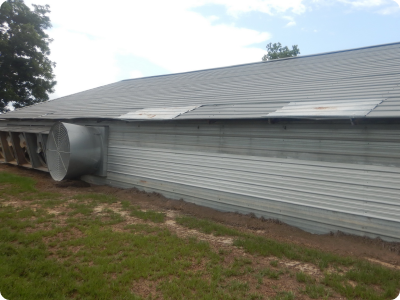
Roofing panels exhibited dents, warping, sagging, and evidence of replacement.
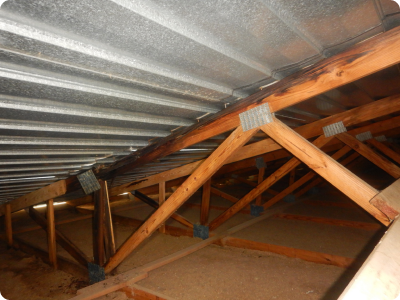
Dark brown stains were on the attic insulation, the attic side of the ceiling, and on the roof framing members.
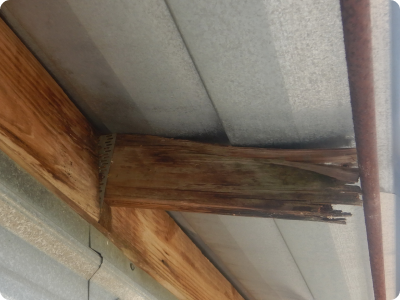
Moisture stains and sagging roof framing below sagged roofing indicated long-term water intrusion.
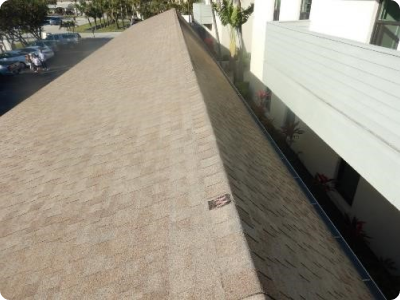
Replaced siding panels indicated historical repair.
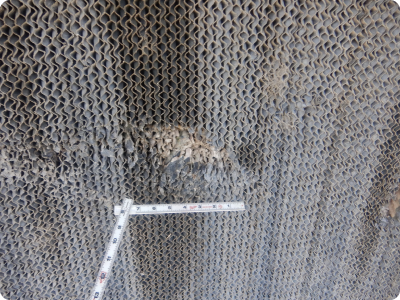
Tears and section loss on evaporative cooling pads.
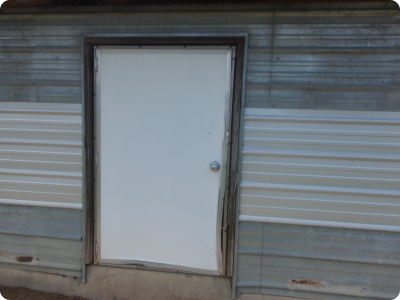
Door and frame bent and warped.
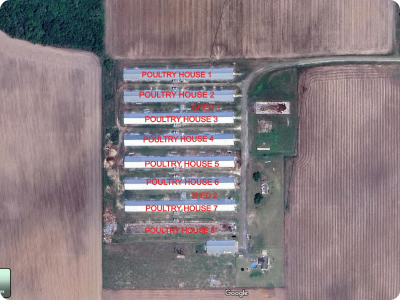
Aerial image showing historical roof repairs/replacements.
Repair Strategy
The engineering evaluation confirmed that roofing, envelope, and structural systems were primarily impacted by long-term moisture intrusion and deferred maintenance, with storm-related damage limited to localized areas.
- Roofing Consulting: Damage was attributed to age, maintenance activities, and moisture exposure rather than storm forces. Localized repairs were recommended, consistent with building code requirements.
- Building Envelope Evaluation: Evidence of deterioration and replacement indicated deferred maintenance. Targeted repairs and improved maintenance practices were advised to restore performance.
- Structural Assessment: Moisture-related sagging of roof framing required reinforcement and remediation to ensure long-term reliability.
- Remediation Planning: Phased repair strategies were developed to address roofing, envelope, and structural deficiencies. Recommendations were aligned with long-term asset management goals and supported by supported by representative Engineer of Record services to facilitate phased implementation, code compliance, and long-term facility reliability.
Conclusions
- The Facility Condition Assessment confirmed that long-term moisture exposure and deferred maintenance were the primary contributors to observed damage.
- Forensic Investigation distinguished limited storm-related impacts from systemic deterioration.
- Engineering Analysis validated structural reliability concerns, particularly moisture-related sagging.
- Remediation Planning focused on phased repair strategies to reinforce reliability, address moisture intrusion, and improve envelope performance.
- Engineer of Record Services ensured compliance with building codes and supported implementation of remediation strategies.
Why This Matters
Facility Condition Assessments provide owners with evidence-based clarity on building system performance, separating storm impacts from maintenance issues. They deliver actionable forensic insights that guide remediation planning and capital investment decisions, while engineering strategies reduce risk, reinforce reliability, and extend facility life.
By integrating Facility Condition Assessments, targeted engineering investigation, and remediation planning, owners gain the technical clarity needed to prioritize repairs, manage capital investments, and extend facility service life.
Evaluating Engineering Partners?
We can provide representative redacted reports that demonstrate
our documentation approach, technical analysis structure, and
reporting methodology.